On 23 August 2023, a small lander named Vikram touched down on the Moon near its south pole. India became the fourth country to achieve a soft landing on the Moon and the first to do so in the south polar region. Across the country, people watched live; schools held special screenings, and the date is now celebrated as National Space Day.
That moment was the result of six decades of work, starting with modest beginnings in a fishing village in Kerala. This article tells the story of ISRO space missions, from the first sounding rocket to Chandrayaan-3 and the human spaceflight programme.
Humble beginnings
India’s space journey began in the early 1960s under the leadership of physicist Vikram Sarabhai, often called the father of the Indian space programme. In 1962, the government set up the Indian National Committee for Space Research. A year later, on 21 November 1963, India launched its first sounding rocket from Thumba, near Thiruvananthapuram.
Thumba was chosen because it lies close to the magnetic equator, which made it ideal for studying the upper atmosphere. A church in the village, St Mary Magdalene Church, was offered to scientists as an office and workshop; it now houses a space museum. Famous photographs from this era show rocket parts being carried on bicycles and a bullock cart, a vivid image of how much was achieved with very little.
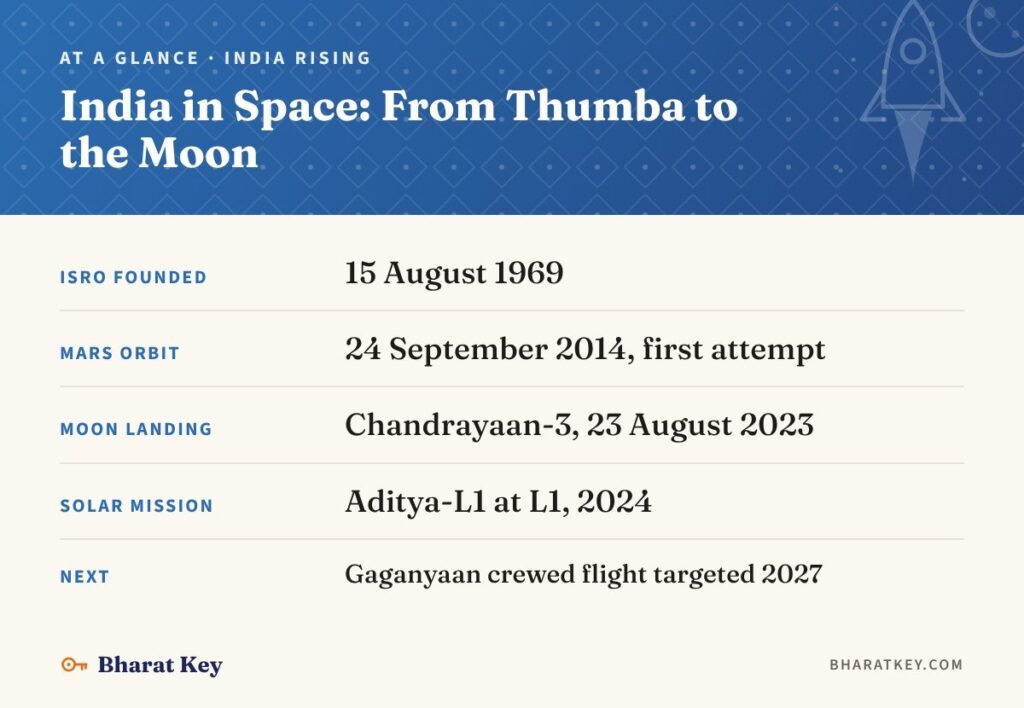
The Indian Space Research Organisation (ISRO) was founded on 15 August 1969. In 1972, the government created the Department of Space and the Space Commission.
Building capability: satellites and rockets
The first satellites
India’s first satellite, Aryabhata, named after the 5th-century mathematician, was launched on 19 April 1975 on a Soviet rocket. It was followed by Bhaskara, an experimental Earth observation satellite.
In 1980, India launched the Rohini satellite on its own SLV-3 rocket, becoming one of a small group of countries able to launch satellites into orbit. The project director for SLV-3 was A.P.J. Abdul Kalam, who later led India’s missile programme and became President of India.
PSLV: the workhorse
The Polar Satellite Launch Vehicle (PSLV), first successfully launched in 1994, became ISRO’s most reliable rocket. It has launched hundreds of Indian and foreign satellites. On 15 February 2017, PSLV-C37 placed 104 satellites into orbit in a single mission, a world record at the time.
GSLV and LVM3
The Geosynchronous Satellite Launch Vehicle (GSLV) required mastering cryogenic engine technology, which India developed indigenously after years of effort. The heavier LVM3 (earlier called GSLV Mk III) now carries ISRO’s most ambitious payloads, including Chandrayaan-3 and, in future, the Gaganyaan crew module.
Satellites that serve daily life
Much of ISRO’s work is less visible but deeply practical:
- INSAT and GSAT communication satellites support television, telecommunications and weather services.
- Remote sensing satellites help with agriculture, water resources, forestry, urban planning and disaster management.
- NavIC, India’s regional satellite navigation system, provides positioning services over India and the surrounding region.
- Weather satellites have improved cyclone forecasting, helping save lives along India’s coasts.
Exploring the Moon and Mars
Chandrayaan-1 (2008)
India’s first lunar mission, Chandrayaan-1, launched in October 2008. It carried instruments from India and other countries. One of its most important results came from NASA’s Moon Mineralogy Mapper on board, which, together with other data, provided strong evidence of water molecules on the lunar surface. Chandrayaan-1 also released the Moon Impact Probe, which struck the surface near the south pole.
Mangalyaan (2013–2014)
The Mars Orbiter Mission, popularly called Mangalyaan, was launched on 5 November 2013 and entered orbit around Mars on 24 September 2014. India became the first Asian country to reach Mars orbit and the first nation in the world to do so on its first attempt. The mission became famous for its low cost compared with other interplanetary missions, and it operated for years beyond its planned lifetime.
Chandrayaan-2 (2019)
Chandrayaan-2 included an orbiter, a lander and a rover. The orbiter successfully entered lunar orbit and continues to send valuable data. However, the Vikram lander lost contact during its final descent in September 2019 and crash-landed. The setback was a painful moment, but the lessons learned shaped the next attempt.
Chandrayaan-3 (2023)
Chandrayaan-3 was launched on 14 July 2023 on an LVM3 rocket from the Satish Dhawan Space Centre in Sriharikota. It carried a lander, again named Vikram, and a small rover named Pragyan. Engineers strengthened the lander’s legs, expanded its landing zone, added more fuel and improved its software to handle failures.
On 23 August 2023, Vikram landed near the lunar south pole. The landing site was named Shiv Shakti Point. Over the following lunar day, Pragyan rolled out and studied the surface. Among its findings, its instruments confirmed the presence of sulphur in the lunar soil near the south pole and measured temperatures in the topsoil. Vikram also performed a small “hop”, lifting off and landing again, which demonstrated technologies useful for future sample-return missions.
The government declared 23 August as National Space Day.
Studying the Sun and the universe
- Astrosat (2015): India’s first dedicated multi-wavelength space observatory, studying stars, galaxies and black holes.
- Aditya-L1 (2023): India’s first solar mission, launched on 2 September 2023. It reached a halo orbit around the Sun–Earth Lagrange Point 1 (L1), about 1.5 million kilometres from Earth, in January 2024, from where it observes the Sun continuously.
- XPoSat (2024): An X-ray polarimetry satellite launched on 1 January 2024 to study bright X-ray sources such as black holes and neutron stars.
Recent milestones
- SpaDeX docking: In January 2025, ISRO’s Space Docking Experiment successfully docked two satellites in orbit, making India the fourth country to demonstrate space docking. Docking is essential for future space stations and complex missions.
- NISAR: The NASA-ISRO Synthetic Aperture Radar satellite, a joint Earth observation mission, was launched on a GSLV in July 2025. It maps changes in Earth’s land and ice surfaces in great detail.
- An Indian on the International Space Station: In June 2025, Indian Air Force Group Captain Shubhanshu Shukla flew to the International Space Station on the commercial Axiom-4 mission, becoming the first Indian to visit the ISS and the second Indian in space after Rakesh Sharma, who flew aboard a Soviet mission in 1984.
Gaganyaan: India’s human spaceflight programme
Gaganyaan aims to send Indian astronauts, called gaganyatris, into low Earth orbit on an Indian rocket. The plan is to carry a crew of up to three to an orbit of about 400 km for a short mission and return them safely to Earth, with a splashdown at sea.
Before crewed flights, ISRO has been carrying out a series of tests, including abort tests of the crew escape system and uncrewed orbital missions. The first uncrewed flight is designed to carry a humanoid robot, Vyommitra, to test systems. As of autumn 2026, ISRO said its first uncrewed Gaganyaan flight was nearing launch, with the first crewed mission targeted for 2027, subject to the success of the test programme. Four Indian Air Force test pilots were named as astronaut-designates in February 2024.
Human spaceflight is extremely demanding, and timelines have shifted as safety tests continue. You can follow official updates on the ISRO website.
A timeline of key milestones
| Year | Milestone |
|---|---|
| 1963 | First sounding rocket launched from Thumba, Kerala |
| 1969 | ISRO founded |
| 1975 | Aryabhata, India’s first satellite, launched |
| 1980 | Rohini satellite launched on India’s SLV-3 rocket |
| 1984 | Rakesh Sharma becomes the first Indian in space, aboard a Soviet mission |
| 1994 | First successful PSLV launch |
| 2008 | Chandrayaan-1 launched to the Moon |
| 2014 | Mangalyaan enters Mars orbit on the first attempt |
| 2017 | PSLV launches 104 satellites in one mission |
| 2019 | Chandrayaan-2 orbiter reaches the Moon; lander lost |
| 2022 | Vikram-S, India’s first private rocket, flies |
| 2023 | Chandrayaan-3 lands near the lunar south pole; Aditya-L1 launched |
| 2025 | SpaDeX docking; NISAR launched; Shubhanshu Shukla visits the ISS |

Space technology in everyday life
ISRO’s satellites touch daily life in ways many people never notice.
- Disaster warnings: Satellite-based weather forecasting and communication have transformed cyclone preparedness. When severe cyclones approach the coasts of Odisha and Andhra Pradesh, early warnings now allow authorities to evacuate hundreds of thousands of people, greatly reducing loss of life compared with earlier decades.
- Fishing: Satellite data helps identify potential fishing zones, and messaging services send alerts to fishermen about weather and safe areas.
- Farming: Remote sensing supports crop estimates, drought monitoring and planning for irrigation.
- Navigation: NavIC provides positioning services used in transport, mapping and timing.
- Education and health: Satellites have long been used for distance education and telemedicine in remote areas.
Watching a launch in person
Most of ISRO’s major launches take place from the Satish Dhawan Space Centre at Sriharikota, an island on the coast of Andhra Pradesh, about 100 km north of Chennai. ISRO has a Launch View Gallery where members of the public can watch launches. Registration usually opens online a few days before a launch and fills up quickly. Watching a rocket lift off and feeling the rumble a few seconds later is an experience few people forget.
The Vikram Sarabhai Space Centre museum at Thumba, near Thiruvananthapuram, and science centres in other cities offer exhibitions on India’s space history.
The road ahead
India’s space plans for the coming decades include:
- Bharatiya Antariksh Station: An Indian space station, with the first module targeted for launch later this decade and the station envisaged to be operational around 2035.
- Chandrayaan-4: A lunar sample-return mission.
- Lunar Polar Exploration (LUPEX): A joint mission with Japan’s space agency JAXA to explore the Moon’s south polar region.
- Venus Orbiter Mission: Approved in 2024 to study the atmosphere and surface of Venus.
- An Indian on the Moon: The government has spoken of an ambition to land an Indian on the Moon by 2040.
Timelines for such ambitious missions often change, so treat these as goals rather than fixed dates.
The rise of private space companies
Since reforms in 2020 opened the space sector to private companies, Indian space startups have grown quickly. IN-SPACe, a new regulator and promoter, authorises and supports non-government space activities.
- Skyroot Aerospace launched Vikram-S, India’s first privately developed rocket, on a suborbital flight in November 2022.
- Agnikul Cosmos flew its Agnibaan SOrTeD vehicle in May 2024, powered by what it described as the world’s first single-piece 3D-printed semi-cryogenic rocket engine.
- Dozens of startups are building satellites, ground stations, Earth observation services and propulsion systems.
The aim is to increase India’s share of the global space economy and create high-skilled jobs.
Why India’s space programme matters
India’s space programme has always emphasised using space technology for national development: communication, weather forecasting, disaster warning, agriculture, navigation and education. At the same time, missions like Mangalyaan, Chandrayaan-3 and Aditya-L1 show that India can do world-class science.
Perhaps most importantly, the programme inspires. Many of its leading engineers, including the women behind recent missions, came from ordinary backgrounds. Read about some of them in our feature on Indian women in science.
Inspiring the next generation
ISRO and the government run programmes to bring space science to students, such as the Young Scientist Programme (YUVIKA), which invites school students to spend time at ISRO centres. Many schools mark National Space Day with exhibitions, quizzes and model rocket projects. Students can also follow live launch broadcasts on ISRO’s official channels and visit space museums at Thumba, Bengaluru and Ahmedabad. Whether they become engineers, scientists, teachers or entrepreneurs, these experiences help young people imagine a future shaped by space technology.
Key takeaways
- India’s space programme grew from a rocket launch at Thumba in 1963 to landing near the Moon’s south pole in 2023.
- PSLV, GSLV and LVM3 rockets give India independent access to space.
- Mangalyaan, Chandrayaan-3, Aditya-L1 and SpaDeX are landmark achievements.
- Gaganyaan aims to send Indian astronauts to orbit, with the first crewed flight targeted for 2027.
- Private companies such as Skyroot and Agnikul are expanding India’s space economy.
Frequently asked questions
When did Chandrayaan-3 land on the Moon?
Chandrayaan-3’s Vikram lander touched down near the Moon’s south pole on 23 August 2023.
What is National Space Day in India?
India celebrates National Space Day on 23 August to mark Chandrayaan-3’s landing on the Moon.
Who founded ISRO?
ISRO was founded on 15 August 1969. Vikram Sarabhai is regarded as the father of the Indian space programme.
Has an Indian been to space?
Yes. Rakesh Sharma flew to space in 1984 aboard a Soviet mission, and Shubhanshu Shukla travelled to the International Space Station on the Axiom-4 mission in 2025.
What is ISRO’s next Moon mission?
ISRO’s planned lunar missions include Chandrayaan-4, designed to collect samples from the Moon and return them to Earth, and the Lunar Polar Exploration mission with Japan’s space agency, JAXA. Launch dates depend on development and testing, so check ISRO’s announcements for current plans.
When will Gaganyaan launch with astronauts?
As of autumn 2026, ISRO was targeting its first crewed Gaganyaan mission in 2027, after a series of uncrewed test flights. Check ISRO’s official updates for the latest schedule.
Can the public watch an ISRO launch?
Yes. ISRO’s Launch View Gallery at Sriharikota is open to the public for many launches. Registration usually opens online a few days before each launch.