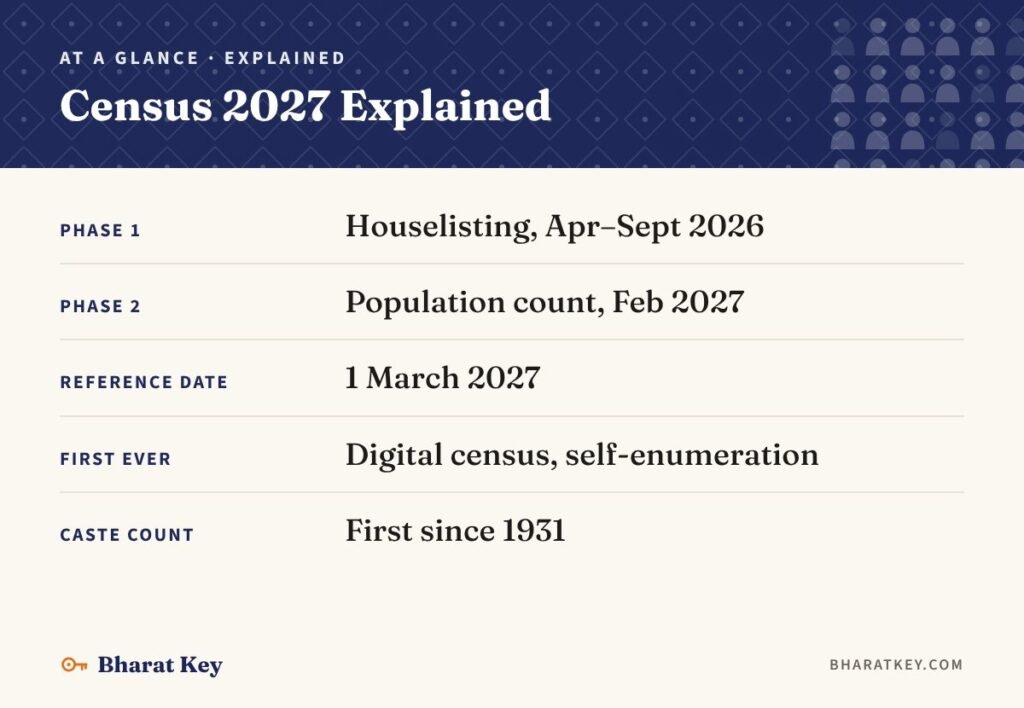
India is in the middle of its biggest counting exercise in a generation. Census 2027, the first national census since 2011, is being carried out in two phases between April 2026 and March 2027. It is India’s first digital census, its first to offer self-enumeration online, and the first since 1931 to collect comprehensive caste data.
The results will shape government policy, welfare schemes, research and, potentially, the political map of India for years to come. This explainer covers what is happening, when, how it works and why it matters. It reflects official announcements available as of November 2026; check the Census of India website for the latest updates.
Why a census, and why now?
A census is a complete count of a country’s population, along with information about housing, amenities, education, work, language, religion, migration and more. India has conducted a census every ten years since 1881, making its series one of the longest continuous records of any country.
The census due in 2021 was postponed because of the COVID-19 pandemic. As a result, India has gone more than fifteen years without fresh census data. Many policies and estimates have relied on 2011 figures, projections and sample surveys, which become less reliable with time. Census 2027 will provide a new baseline.
Census 2027 is the 16th census in the series and the 8th since Independence. It is conducted by the Office of the Registrar General and Census Commissioner, India, under the Ministry of Home Affairs, under the Census Act, 1948.
The two phases and key dates
Phase 1: Houselisting and Housing Census
The first phase, Houselisting and Housing Census (HLO), took place between 1 April and 30 September 2026. Each state and union territory chose its own 30-day window within that period for door-to-door operations.
In this phase, enumerators listed every building and household and collected information on housing conditions and amenities, such as:
- Building materials and condition of the house
- Number of rooms and ownership status
- Drinking water source, toilets, drainage and cooking fuel
- Electricity and lighting
- Assets such as phones, computers, vehicles and appliances
- Internet access
Phase 2: Population Enumeration
The second phase, Population Enumeration (PE), is scheduled for February 2027. This is when details of every individual are recorded, including age, sex, marital status, religion, caste, mother tongue and other languages, literacy and education, occupation, disability and migration.
The reference date
Census data is recorded as of a specific moment, called the reference date. For most of India, it is 00:00 hours on 1 March 2027. For the snow-bound and non-synchronous areas of Ladakh, Jammu and Kashmir, Himachal Pradesh and Uttarakhand, where winter makes fieldwork difficult, the reference date is 00:00 hours on 1 October 2026, so enumeration there takes place earlier.
| Stage | Timing |
|---|---|
| Houselisting and Housing Census | 1 April – 30 September 2026 (30-day window per state/UT) |
| Self-enumeration (Phase 1) | 15 days before each state’s houselisting window |
| Reference date: snow-bound areas | 1 October 2026 |
| Population Enumeration | February 2027 |
| Reference date: rest of India | 1 March 2027 |
India’s first digital census
Earlier censuses relied on paper forms that were later scanned and processed. Census 2027 is the first in which enumerators collect data on mobile apps on Android and iOS devices. The government has said that around 30 lakh (3 million) field functionaries, many of them government school teachers and officials, are involved.
Digital collection is expected to:
- Speed up results, since data flows directly to central servers rather than through paper processing.
- Reduce errors through built-in checks, drop-down menus and validation.
- Improve monitoring, since supervisors can track progress in real time.
- Allow geo-tagging of buildings, which helps with mapping and planning.
Self-enumeration: counting yourself online
For the first time, households have the option to fill in their own census information online before the enumerator visits. In Phase 1, a 15-day self-enumeration window opened before each state’s houselisting period, through the official portal, se.census.gov.in.
The process works like this:
- A household member registers with the name of the head of household and a mobile number, verified by OTP.
- They choose a language, locate their home on a map and fill in the questionnaire.
- After final submission, the portal generates a Self-Enumeration ID (SE ID), also sent by SMS and email.
- When the enumerator visits, the household shares the SE ID. If the details match, the data is accepted; if not, the enumerator collects the information again.
Self-enumeration is optional. Every household is still visited by an enumerator. If a self-enumeration option is offered for Phase 2, details will be announced on official channels.
The caste count
On 30 April 2025, the Union Cabinet Committee on Political Affairs approved the inclusion of caste enumeration in the census. Since Independence, Indian censuses have recorded Scheduled Castes and Scheduled Tribes, but not other castes. The last comprehensive caste count in a census was in 1931, under British rule.
Caste data in Census 2027 will be collected electronically during the Population Enumeration phase. Supporters argue that up-to-date caste data is essential for designing reservations and welfare policies, especially for Other Backward Classes (OBCs), and for understanding social inequality. Critics have raised concerns about the complexity of classifying thousands of caste groups and sub-groups, the risk of errors, and the possibility that the data could deepen social divisions. Several states, such as Bihar, Karnataka and Telangana, have conducted their own caste surveys in recent years, which have fed into the national debate.
How caste information is collected, classified and published will be closely watched by researchers, political parties and civil society.
A brief history of India’s census
India’s census tradition is one of the oldest in the world. The first census exercise under British rule was carried out between 1865 and 1872, but it was not conducted at the same time across the country. The first synchronous census, held simultaneously across British India, took place in 1881, and censuses have been held every ten years since then, until the pandemic disrupted the 2021 round.
Some landmarks in the series:
- 1931: The last census to record full caste data.
- 1951: The first census of independent India.
- 2011: The 15th census, which counted about 121 crore (1.21 billion) people. It recorded a literacy rate of about 74 per cent and a sex ratio of 943 females per 1,000 males.
Each census has added new questions as the country changed, from housing amenities to disability and, in 2011, the use of mobile phones and computers. Census 2027 continues that evolution with digital collection and questions on internet access.
Census, NPR and surveys: what’s the difference?
- Census: A complete count of every person and household, conducted every ten years under the Census Act, 1948.
- National Population Register (NPR): A register of usual residents, first prepared alongside the 2011 Census. It is governed by different rules from the census.
- Sample surveys: Surveys such as the National Family Health Survey (NFHS) and the Periodic Labour Force Survey (PLFS) collect detailed data from a representative sample of households. They are conducted more frequently but rely on census data to design their samples and estimate totals.
A fresh census will therefore improve the accuracy of many other statistics as well.
Is census data confidential?
Yes. Under the Census Act, 1948, information collected about individuals is confidential. It cannot be shared with other government departments for purposes such as tax or law enforcement, and it cannot be used as evidence in court. Census results are published only in aggregated form, such as totals for a district or state, and not in a way that identifies individuals.
Questions about data security in a digital census are natural. The government has said that data is encrypted and stored on secure servers. Citizens should share census information only with authorised enumerators carrying official identification, or through the official self-enumeration portal, and should be wary of fake websites, calls or messages claiming to be from the census.
Why Census 2027 matters
Policy and welfare
Census data underpins how governments plan schools, hospitals, roads, housing, water supply and welfare schemes, and how they allocate funds among states and districts. Updated figures will improve targeting of programmes for food security, housing, health and education.
Delimitation
Under the Constitution, the number of seats in the Lok Sabha and state legislative assemblies, and the boundaries of constituencies, are adjusted through delimitation based on census figures. Seat allocation among states has been frozen on the basis of the 1971 Census, and the Constitution provides that it will remain so until the publication of figures from the first census taken after 2026. Census 2027 is therefore expected to open the door to a new delimitation exercise.
This is politically significant. Because population growth has been faster in some northern states than in many southern states, a population-based redistribution of seats could shift political weight between regions. Southern states have expressed concern that they could be penalised for success in stabilising population growth, and the issue is likely to be one of the most important national debates of the coming years.
Women’s reservation
The Constitution (106th Amendment) Act, 2023, popularly known as the Nari Shakti Vandan Adhiniyam, provides for reserving one-third of seats in the Lok Sabha and state assemblies for women. It is to take effect after a delimitation exercise based on the first census conducted after the Act came into force. Census 2027 is therefore a key step towards implementing women’s reservation.
Research and business
Researchers, businesses, non-profit organisations and journalists rely on census data to understand India’s changing population: urbanisation, migration, ageing, language use and household conditions. After a gap of more than fifteen years, the new data will reveal how much India has changed.
What to expect from the results
Based on previous censuses, provisional population totals are usually released within months of enumeration, followed by detailed tables over the following years. With digital collection, the government has said results could be available faster than in the past. Key questions the data will help answer include:
- How large and how urban is India’s population today?
- How have literacy, education and household amenities improved since 2011?
- Which states and cities have grown fastest, and how has migration changed?
- How is India’s population ageing?
- What does caste data reveal about the social composition of the country?
How you can help
- Participate fully and honestly. Accurate data benefits everyone.
- Verify enumerators. Ask for official identification before sharing information.
- Use only the official portal for any self-enumeration option.
- Watch out for scams. Census officials will never ask for bank details, OTPs for financial transactions or payment.
- Share reliable information with older relatives and neighbours who may have questions.
Common questions from households
Do I have to answer every question? Under the Census Act, people are required to answer census questions truthfully, but enumerators are trained to explain questions and record answers as given.
What if I was away from home during houselisting? Enumerators may revisit, and households can contact local census officials. Population enumeration in 2027 records people where they are on the reference date, so temporary absence is accounted for.
Will the census ask for documents? Census enumeration is based on information provided by households. Be wary of anyone demanding documents, bank details or money in the name of the census.
Key takeaways
- Census 2027 is India’s first census since 2011, delayed by the pandemic.
- It is the country’s first digital census, with an online self-enumeration option.
- Houselisting took place between April and September 2026; population enumeration is due in February 2027.
- Caste will be counted comprehensively for the first time since 1931.
- The results are expected to shape welfare policy, delimitation of constituencies and women’s reservation.
Frequently asked questions
When is Census 2027?
Census 2027 has two phases. Houselisting and Housing Census took place between April and September 2026. Population Enumeration is scheduled for February 2027, with a reference date of 1 March 2027 for most of India.
Is Census 2027 digital?
Yes. It is India’s first digital census, with data collected through mobile apps and an online self-enumeration option.
Will Census 2027 count caste?
Yes. The government approved caste enumeration in April 2025, and caste details will be collected during the Population Enumeration phase. It is the first comprehensive caste count since 1931.
Is my census information safe?
The Census Act, 1948, makes individual census information confidential. It cannot be used as evidence in court or shared for other purposes, and results are published only in aggregate form.
When will Census 2027 results be released?
The government has not fixed exact dates for releasing results. Historically, provisional population totals have been published within months of enumeration, with detailed tables over the following years. Digital collection is expected to speed this up. Watch the official Census of India website for announcements.
Why was the 2021 Census delayed?
The census due in 2021 was postponed because of the COVID-19 pandemic.
What is the self-enumeration portal for Census 2027?
The official self-enumeration portal is se.census.gov.in. Use only this portal and ignore links received from unknown sources.
For more explainers, read about how UPI works and GI tags in India. Want a lighter read? Try our 30 interesting facts about India.