Why does a packet of genuine Darjeeling tea cost more than ordinary tea? Why can’t a factory in another country sell its silk as “Banarasi”? Part of the answer lies in a legal badge of origin called a GI tag, short for Geographical Indication.
GI tags have become a familiar part of Indian news, from disputes over the origin of the rasgulla to celebrations when a local craft wins recognition. This explainer covers what a GI tag is, how products earn one, famous Indian examples, the benefits and limitations, and how buyers can use GI tags to make better choices.
What is a Geographical Indication?
A Geographical Indication is a sign used on products that come from a specific place and have qualities, a reputation or characteristics that are essentially due to that origin. The link might come from natural factors such as soil and climate, from human skills and traditions, or from both.
For example:
- Darjeeling tea owes its distinctive flavour to the climate, altitude and soil of the Darjeeling hills, along with local processing skills.
- Banarasi sarees owe their character to the weaving traditions of Varanasi and surrounding districts, passed down through generations.
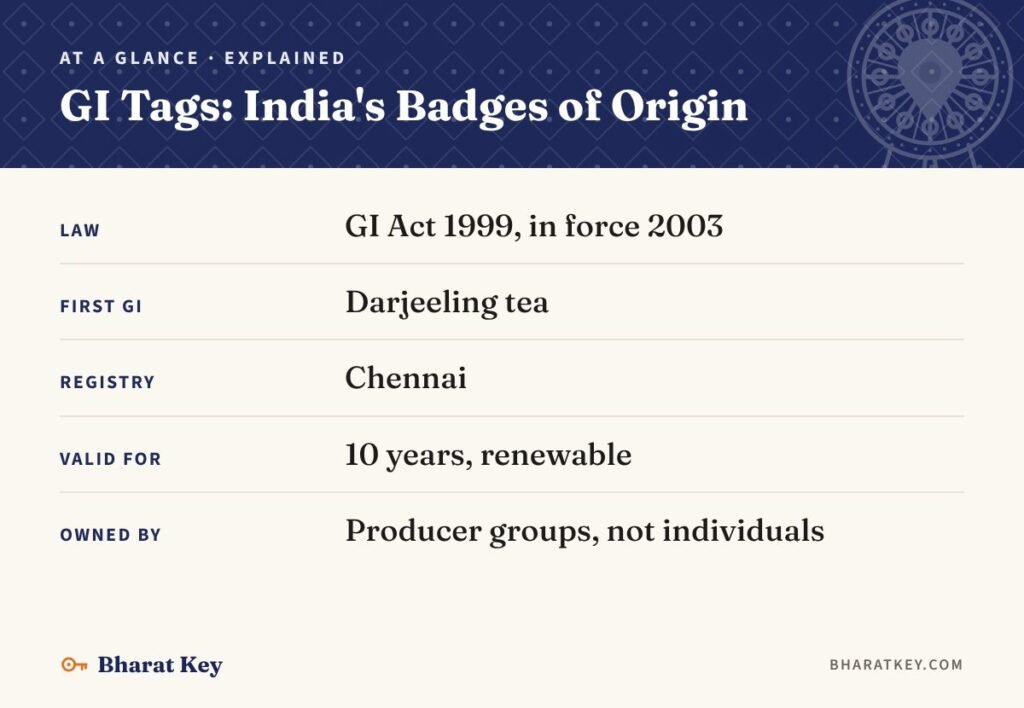
A GI tag does not belong to a single company. It is a collective right that can be used by all producers in the defined area who meet the specified standards.
GI versus trademark
A trademark identifies a specific company or brand, such as a particular tea company. A GI identifies a place of origin and the qualities associated with it, and can be used by any authorised producer from that place. A tea company in Darjeeling might have its own trademark and also use the Darjeeling GI.
The law in India
India passed the Geographical Indications of Goods (Registration and Protection) Act in 1999, and it came into force in September 2003. The law was enacted partly to meet India’s obligations under the World Trade Organization’s TRIPS Agreement, which requires member countries to protect geographical indications.
GIs in India are registered by the Geographical Indications Registry in Chennai, part of the Office of the Controller General of Patents, Designs and Trade Marks. You can search registered GIs on the Intellectual Property India website.
Darjeeling tea was the first product to be registered as a GI in India, in 2004–05.
Categories of GI
Indian GIs are registered in several categories:
- Agricultural: such as Darjeeling tea, Basmati rice, Alphonso mango, Nagpur orange, Kashmir saffron and Coorg arabica coffee.
- Handicrafts: such as Madhubani painting, Channapatna toys, Pashmina, Bidriware and Kondapalli toys.
- Manufactured goods: such as Feni from Goa.
- Foodstuffs: such as Tirupati laddu, Hyderabadi haleem, Bikaneri bhujia, Dharwad pedha and Rasagola.
- Natural goods: such as Makrana marble.
Textiles, from Banarasi brocades to Kanchipuram silk, Pochampally ikat and Muga silk, make up one of the largest groups. Our guide to handloom sarees introduces many of them.
How a product gets a GI tag
- An association applies. Applications are made by an association of producers, a cooperative, a government body or another organisation representing the interests of producers. Individuals cannot own a GI.
- The application describes the product. It includes the product’s special characteristics, the method of production, the history and evidence of its link with the place, and a map of the geographical area.
- Examination. The GI Registry examines the application, sometimes with help from a consultative group of experts.
- Publication and objection. The application is published in the GI Journal, and anyone can file an objection within a set period.
- Registration. If there are no successful objections, the GI is registered.
- Authorised users. Individual producers in the area can then register as authorised users to use the GI legally.
A GI registration in India is valid for ten years and can be renewed indefinitely.
Famous Indian GI products
| Product | State | Category | What makes it special |
|---|---|---|---|
| Darjeeling tea | West Bengal | Agricultural | Muscatel flavour from Himalayan terroir |
| Kashmir saffron | Jammu and Kashmir | Agricultural | Long, deep-red stigmas with strong aroma |
| Alphonso mango | Maharashtra (Ratnagiri, Sindhudurg and nearby areas) | Agricultural | Rich sweetness, aroma and texture |
| Basmati rice | Several northern states | Agricultural | Long grains and fragrance |
| Banarasi brocades and sarees | Uttar Pradesh | Handicraft | Zari brocade weaving traditions |
| Kanchipuram silk | Tamil Nadu | Handicraft | Heavy silk with interlocked borders |
| Madhubani painting | Bihar | Handicraft | Mithila folk art with bold lines and motifs |
| Channapatna toys | Karnataka | Handicraft | Lacquered wooden toys |
| Tirupati laddu | Andhra Pradesh | Foodstuff | Temple prasadam with a distinctive recipe |
| Hyderabadi haleem | Telangana | Foodstuff | Slow-cooked meat and wheat stew |
| Feni | Goa | Manufactured | Spirit distilled from cashew apple or coconut |
| Chak-hao (black rice) | Manipur | Agricultural | Aromatic black rice used in festivals |
The famous rasgulla dispute
One of India’s most famous GI stories involves a sweet. West Bengal and Odisha both claim the rasgulla as their own. In 2017, West Bengal received a GI tag for Banglar Rasogolla (Bengal’s rasgulla). In 2019, Odisha received a GI tag for Odisha Rasagola, which it links to the offerings at the Jagannath Temple in Puri. Each GI protects a distinct regional version, showing that two places can both have protected traditions of a similar product.
Basmati and international disputes
GIs can be contested internationally. Basmati rice is grown in both India and Pakistan, and both countries claim it as part of their heritage. India’s application to register Basmati as a protected geographical indication in the European Union has faced opposition from Pakistan, and the issue has been under consideration for years. Disputes such as these show that GIs can carry significant trade value.
Benefits of a GI tag
- Protection against misuse: Only authorised producers from the region can use the name, which helps prevent counterfeit products.
- Better prices: GI-tagged products can command premium prices, especially in export markets.
- Preserving traditions: By defining traditional methods, GIs can help preserve crafts and agricultural practices.
- Rural development: GIs can support livelihoods in rural and remote areas, where many traditional products are made.
- Tourism and identity: GIs build pride and can attract tourism to the region.
Limitations and challenges
GI tags are not a magic solution.
- Low awareness: Many consumers do not know what a GI tag is or how to check for it.
- Weak enforcement: Counterfeit products are still common, and taking legal action can be expensive and slow for small producers.
- Few authorised users: For some GIs, relatively few producers have registered as authorised users, limiting the benefits.
- Marketing gaps: Without branding and market access, a GI alone does not guarantee better incomes.
- Quality control: Maintaining consistent standards requires active producer organisations.
The government has tried to address some of these issues through promotional campaigns, a GI logo and tagline, and efforts to link GI products with e-commerce platforms, exports and the “One District One Product” initiative.

GI products to look for, region by region
- North: Kashmir saffron, Pashmina, Kangra tea, Kullu shawls, Basmati rice, Phulkari embroidery, Amritsari papad-wadiyan and Lucknow chikankari.
- West: Alphonso mango, Nashik grapes, Kolhapuri chappals, Paithani sarees, Patan Patola, Bikaneri bhujia, Blue Pottery of Jaipur and Goa’s Feni.
- East: Darjeeling tea, Banglar Rasogolla, Odisha Rasagola, Kandhamal haldi, Sambalpuri textiles, Madhubani paintings and Bhagalpur silk.
- Northeast: Assam’s Muga silk, Naga king chilli, Manipur’s Chak-hao, Meghalaya’s Khasi mandarin and Tripura’s Queen pineapple.
- South: Kanchipuram silk, Mysore silk, Coorg arabica coffee, Malabar pepper, Tirupati laddu, Hyderabadi haleem, Channapatna toys, Aranmula kannadi (metal mirror) and Pochampally ikat.
Geographical indications around the world
India’s GI system is part of a global framework. Some of the world’s most famous products are protected GIs, including Champagne from France, Parmigiano Reggiano cheese from Italy, Scotch whisky from Scotland and Roquefort cheese from France. The European Union has one of the most extensive GI systems in the world and has signed agreements to protect GIs with many trading partners.
Under the WTO’s TRIPS Agreement, wines and spirits receive a higher level of protection than other products. India and several other developing countries have long argued that this stronger protection should be extended to all products, including Darjeeling tea, Basmati rice and handicrafts, so that their producers receive the same safeguards. Recognition of Indian GIs abroad, through trade agreements and registrations in other countries, is an ongoing effort.
GI tourism
Many GI products are tied to beautiful places, which makes them natural tourism attractions. You can visit tea estates in Darjeeling, saffron fields in Pampore when the crocuses bloom in late October and November, weaving clusters in Varanasi and Kanchipuram, and toy-makers’ workshops in Channapatna. Buying directly from producers, with a guide or through a cooperative, supports the communities that keep these traditions alive.
How buyers can use GI tags
- Look for the GI mention and logo on packaging or labels, along with the name of an authorised user.
- Ask sellers for details about the source, especially for expensive items such as saffron, Pashmina or silk sarees.
- Buy from trusted outlets, such as government emporia, producer cooperatives and reputable brands.
- Check the registry. You can search the GI Registry online to confirm whether a product is registered.
- Be wary of “type” or “style” claims. A product described as “Banarasi-style” or “Darjeeling-type” is not the GI product.
For buyers abroad, especially in the diaspora, GI tags can be a useful guide when ordering Indian products online, though they do not replace careful checking of sellers.
GIs and India’s cultural heritage
India’s GI list is, in a sense, a map of its living heritage. It records the knowledge of weavers, farmers, potters, cooks and artisans across the country. Many of these products also appear in Bharat Key’s stories: the silks of Assam in our Northeast India travel guide, Kashmir saffron in our article on Indian spices, and Hyderabadi haleem in our Indian street food guide.
Case study: protecting Darjeeling tea
Darjeeling tea shows how a GI can be defended in practice. The Tea Board of India created a distinctive Darjeeling logo in the 1980s and registered it as a certification mark in several countries, before India’s GI law existed. After Darjeeling became India’s first registered GI, the Tea Board continued to monitor the use of the name worldwide, challenging companies that tried to register “Darjeeling” for unrelated products or sell blends that were not genuine.
The lesson for other producers is that registration is only the first step. Protecting a GI requires an organised body that can track misuse, educate buyers and take legal action at home and abroad.
GI tags and small producers
For a handloom weaver in Pochampally or a saffron farmer in Pampore, a GI tag can open doors, but only if it reaches their market. Producer organisations, state governments and non-profits increasingly help artisans register as authorised users, design packaging, sell online and attend trade fairs. When buyers ask for GI products by name and are willing to pay fair prices, those efforts pay off where it matters most: in the incomes of the people who keep India’s traditions alive.
Key takeaways
- A GI tag links a product’s qualities or reputation to its place of origin and protects its name.
- India’s GI law came into force in 2003, and Darjeeling tea was the first registration.
- GIs are collective rights registered by producer bodies; individual producers register as authorised users.
- Benefits include protection from imitation, better prices and preserving traditions, but enforcement and awareness remain challenges.
- Buyers can check labels, ask sellers and search the GI Registry to make sure they are getting the real thing.
Frequently asked questions
What is a GI tag?
A GI tag (Geographical Indication) is a sign used on products that originate from a specific place and have qualities or a reputation linked to that origin. It is a collective right that authorised producers from that place can use.
Which was India’s first GI-tagged product?
Darjeeling tea was the first product registered as a Geographical Indication in India, in 2004–05.
How long is a GI tag valid in India?
A GI registration in India is valid for ten years and can be renewed.
Who issues GI tags in India?
The Geographical Indications Registry in Chennai, under the Office of the Controller General of Patents, Designs and Trade Marks, registers GIs in India.
Can an individual own a GI tag?
No. A GI is registered by an association of producers or a relevant organisation. Individual producers can register as authorised users.
Does a GI tag guarantee quality?
A GI tag guarantees that a product comes from the defined region and follows the production standards set out in its registration. Actual quality still depends on individual producers, so buying from reputable authorised users remains important.
Can GI products be made outside their region?
Similar products can be made elsewhere, but they cannot legally be sold under the protected GI name. For example, silk sarees woven outside the defined area cannot be sold as Kanchipuram silk.