On the coast of Odisha, a few kilometres from the Bay of Bengal, stands a building designed as a vehicle. The Konark Sun Temple was conceived as the chariot of Surya, the Sun God, drawn across the sky by seven horses and rolling on 24 enormous carved wheels. Even in its partly ruined state, it is one of the most astonishing monuments in India.
This guide explains who built Konark, what its design means, why part of it collapsed, and how to make the most of a visit.
Who built the Konark Sun Temple?
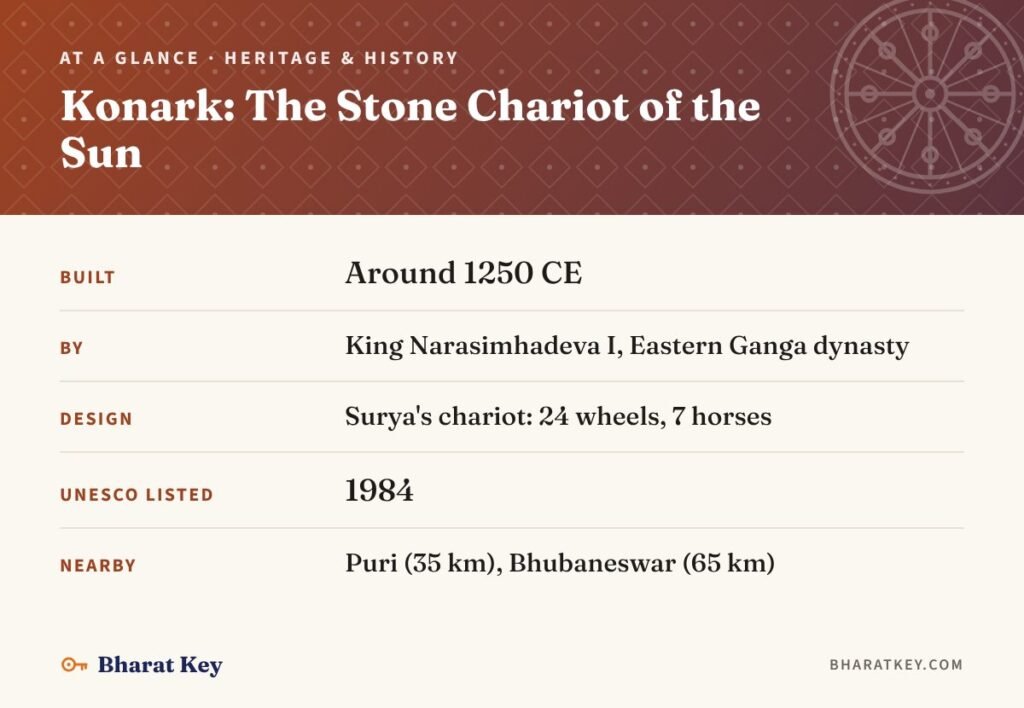
The temple was built around 1250 CE by King Narasimhadeva I of the Eastern Ganga dynasty, which ruled Kalinga, roughly modern Odisha, from the 11th to the 15th centuries. Narasimhadeva I was a powerful ruler who fought successfully against neighbouring powers, and the temple is often seen as a statement of his dynasty’s confidence.
The name Konark is usually explained as a combination of kona (corner) and arka (sun), meaning the sun of the corner, or the sun temple at the corner of the land. Sun worship at this spot is believed to be older than the present temple, and the area is associated in legend with Samba, a son of Krishna, who was said to have been cured of a skin disease by worshipping Surya here.
The Ganga kings were also behind the great Jagannath Temple at Puri in its present form. Together, Puri, Konark and Bhubaneswar form what Odisha Tourism calls the Golden Triangle of temple architecture.
The temple as a chariot
The genius of Konark lies in its concept. The whole temple was designed as Surya’s chariot.
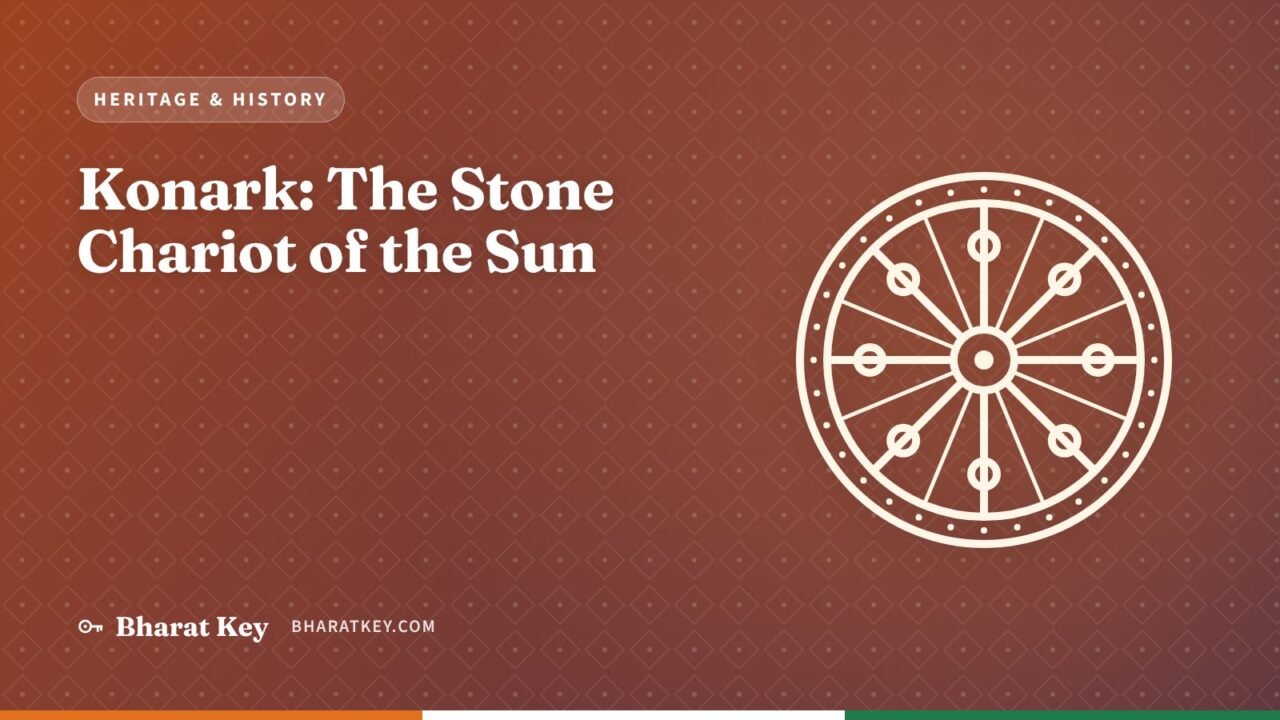
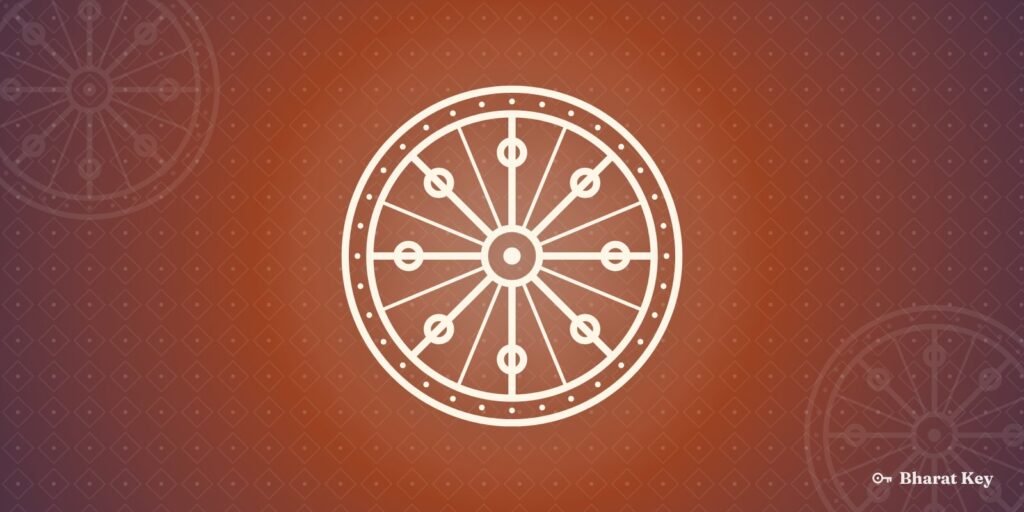
- Twelve pairs of wheels: The platform is carved with 24 wheels, each about 3 metres in diameter. They are often linked to the 12 months of the year, with each pair representing a month, or to the 24 hours of the day.
- Seven horses: Seven horses, representing the seven days of the week, were carved pulling the chariot. Only a few survive.
- Facing east: The temple faces the rising sun, so that the first light of the morning would enter the sanctum.
The wheels that tell time
Each wheel has eight major spokes and eight minor spokes, decorated with medallions of figures and foliage. Local guides like to demonstrate that the wheels work as sundials: by observing where the shadow of a spoke falls, you can read the approximate time of day. Whether or not this was the builders’ main intention, it is a memorable way to look at them.
The Konark wheel has become a symbol of Odisha and of Indian heritage. It appears on the back of India’s ₹10 note in the current series and was used as a backdrop at the G20 Summit venue in New Delhi in 2023.
Kalinga architecture in brief
Konark belongs to the Kalinga style of temple architecture, which developed in Odisha. A typical Kalinga temple has:
- The deul (also called the rekha deul): the main sanctum with a tall, curved tower above the deity.
- The jagamohana (or pidha deul): the assembly hall in front of the sanctum, with a pyramidal roof made of stepped tiers.
- The nata mandira: a dance hall, often a separate structure.
- The bhoga mandapa: a hall for food offerings, in larger temples.
At Konark, the deul is believed to have been extraordinarily tall, perhaps around 70 metres, which would have made it one of the tallest structures in India in its day. It has since collapsed. What visitors see today as the “main temple” is the jagamohana, itself still around 39 metres high, standing on the great wheeled platform.
The collapse and the “Black Pagoda”
Exactly when and why the main tower fell is still debated. Explanations include weak foundations on sandy soil, the enormous weight of the structure, storms and earthquakes, and later damage during invasions. By the time European sailors were navigating this coast, the temple was a prominent landmark. They called it the Black Pagoda, in contrast to the “White Pagoda”, the whitewashed Jagannath Temple at Puri.
Legends add more drama. One story speaks of a huge lodestone at the top of the temple that disrupted ships’ compasses and was removed by sailors, after which the structure weakened. There is no evidence to support this, but it remains a favourite tale.
How Konark was saved
By the 19th century, the site was partly buried in sand and the surviving structure was in danger. In the early 20th century, the colonial administration took a dramatic step: the jagamohana was sealed and filled with sand to stop it collapsing inward. That decision preserved the hall but also hid its interior.
The Archaeological Survey of India now manages the site, and conservation studies on how to safely stabilise and eventually open the interior have continued for years. The temple was inscribed on the UNESCO World Heritage List in 1984.
The sculpture of Konark
Konark is covered in carving, from the base of the platform to the upper tiers of the jagamohana. It is worth walking slowly around the whole building at least twice: once to take in the overall shape, and once to look closely.
What to look for
- Surya images: Three large statues of Surya in green chlorite stone are placed in niches on the south, west and north sides of the deul. They represent the sun at morning, noon and evening.
- Musicians and dancers: The upper terraces of the jagamohana carry large free-standing sculptures of women playing drums, cymbals and flutes. They seem to celebrate the sun with music.
- Daily life: Friezes show hunting, military processions, court scenes, merchants, animals and a giraffe, which suggests contact with traders from Africa.
- Elephants and horses: The war horses at the southern side and the elephants near the entrance are carved with great energy. The statue of a lion overpowering an elephant, which in turn crushes a man, greets visitors at the eastern steps.
- Erotic sculpture: Like many medieval Indian temples, Konark includes sensual and erotic carvings. They are part of a wider tradition in which the temple represents the whole of life, worldly and spiritual.
The poet Rabindranath Tagore is often quoted as saying that at Konark the language of stone surpasses the language of man. Standing before the wheels, it is hard to disagree.
Sun worship in India beyond Konark
Konark is the most famous sun temple in India, but it belongs to a long and widespread tradition. Surya appears in the Rig Veda as a radiant god who drives across the sky in a chariot, and the Gayatri Mantra, one of the most recited Vedic verses, is addressed to the sun in its form as Savitr.
Other important sun temples include:
- Modhera Sun Temple, Gujarat: Built in the early 11th century under the Chaulukya (Solanki) dynasty, it is aligned so that the rising sun lights the sanctum at the equinoxes. Its great stepped tank, the Surya Kund, is one of the finest in India.
- Martand Sun Temple, Kashmir: Built in the 8th century under King Lalitaditya Muktapida of the Karkota dynasty, its ruins stand on a plateau near Anantnag with views of the surrounding mountains.
- Arasavalli Sun Temple, Andhra Pradesh: An active temple near Srikakulam where, on certain days of the year, the rising sun’s rays fall directly on the deity.
- Dakshinarka Temple, Gaya: A sun temple in Bihar associated with pilgrims who perform rituals for their ancestors.
Sun worship is also woven into festivals. Makar Sankranti marks the sun’s movement into Capricorn and is celebrated across India as Pongal, Lohri, Uttarayan and Bihu. Chhath Puja, observed especially in Bihar, Jharkhand and eastern Uttar Pradesh, sees devotees standing in rivers and ponds to offer prayers to the setting and rising sun. Today, Chhath is also celebrated wherever families from these regions have settled, from Mumbai and Delhi to Mauritius and the United States.
Seen in this context, Konark is not an isolated wonder but the grandest expression of a belief shared across India: that the sun is the visible source of life, time and light.
The Konark Archaeological Museum
Run by the Archaeological Survey of India, the museum near the temple displays sculptures and fragments that fell from the building, including pieces from the collapsed tower. It provides useful close-up views of carvings that are high up or damaged on the temple itself. Visit it before or after the temple to understand the scale of what has been lost.
Festivals at Konark
- Konark Dance Festival: Held each year in early December against the backdrop of the temple, this festival brings together classical dancers performing Odissi and other forms. Read our guide to Indian classical dance forms before you go.
- Chandrabhaga Mela: Held on Magha Saptami (in January or February), when pilgrims gather at Chandrabhaga beach nearby to bathe at sunrise and worship the sun.
- International Sand Art Festival: Usually held on Chandrabhaga beach in December, with sand sculptors from India and abroad.
Planning your visit
How to reach Konark
- From Bhubaneswar: About 65 km by road, roughly 1.5 hours. Biju Patnaik International Airport in Bhubaneswar is the nearest airport, and the city has a major railway station.
- From Puri: About 35 km along the scenic Marine Drive, which runs close to the sea. Puri has a railway station with direct trains to many cities.
Most visitors base themselves in Puri or Bhubaneswar and visit Konark as a day trip. Staying in Konark itself is possible and lets you see the temple at quieter times.
Best time to visit
October to March is the most comfortable period, with pleasant temperatures and lower humidity. Summer (April to June) is very hot and humid. The monsoon (July to September) brings heavy rain, and the Odisha coast is sometimes affected by cyclones, so check the weather before travelling.
Practical tips
- Arrive early. Morning light is ideal for photography, and the temple is less crowded.
- Hire an authorised guide. The carvings are dense with stories; a good guide will help you read them. Guides are available at the entrance.
- Check tickets and timings. Entry is ticketed by the ASI; online tickets are often available. Check the ASI website for current fees.
- Stay for the light and sound show. An evening show narrates the temple’s history. Check current schedules locally.
- Combine with Puri. The Jagannath Temple in Puri is one of India’s most important pilgrimage sites. Note that entry to the Jagannath Temple is restricted to Hindus.
- Try Odia food. Look for dalma (lentils with vegetables), chhena poda (a baked cheese dessert) and fresh seafood near the coast. Our guide to regional thalis includes Odisha.
A sample day at Konark
- 6:00 am: Sunrise at Chandrabhaga beach.
- 7:30 am: Breakfast nearby, then enter the temple as it opens.
- 8:00–10:30 am: Walk around the platform, study the wheels and horses, then the sculptures of the jagamohana and the Surya statues.
- 11:00 am: Visit the ASI museum.
- Afternoon: Drive along Marine Drive to Puri, stopping at Ramachandi beach.
- Evening: Explore Puri’s beach and markets.
Why Konark matters
Konark represents the peak of Kalinga temple architecture and one of the most ambitious ideas in Indian building: a temple that is also a vehicle, a calendar and a hymn to the sun. It brings together astronomy, engineering, sculpture and devotion in a single structure.
It also tells a story of loss and preservation. The fallen tower reminds us that even the greatest monuments are fragile, while the sealed and stabilised hall shows how conservation choices made a century ago still shape what we can see today.
If you are interested in how Indian builders worked with climate and water, read our article on the stepwells of India. For another great medieval capital, explore our Hampi travel guide.
Key takeaways
- The Konark Sun Temple was built around 1250 CE by King Narasimhadeva I of the Eastern Ganga dynasty.
- It was designed as the chariot of Surya, with 24 carved wheels and seven horses.
- The tall main tower has collapsed; the surviving structure is the jagamohana, sealed and filled with sand in the early 20th century to keep it standing.
- Its sculpture covers music, dance, daily life, animals and devotion.
- Visit between October and March, early in the morning, and combine the trip with Puri and Bhubaneswar.
Frequently asked questions
Why is the Konark Sun Temple famous?
It is famous for its design as a giant stone chariot of the Sun God with 24 carved wheels and seven horses, its extraordinary sculpture, and its status as a masterpiece of Kalinga architecture. It is a UNESCO World Heritage Site.
Who built the Konark Sun Temple and when?
King Narasimhadeva I of the Eastern Ganga dynasty built it around 1250 CE.
Why is Konark called the Black Pagoda?
European sailors used the dark temple as a landmark and called it the Black Pagoda, distinguishing it from the whitewashed Jagannath Temple in Puri, the “White Pagoda”.
Is there worship inside the Konark Sun Temple today?
No. It is a protected monument managed by the Archaeological Survey of India and is not an active place of worship.
Which Indian currency note features the Konark wheel?
The Konark wheel appears on the back of the ₹10 note in the current series issued by the Reserve Bank of India.