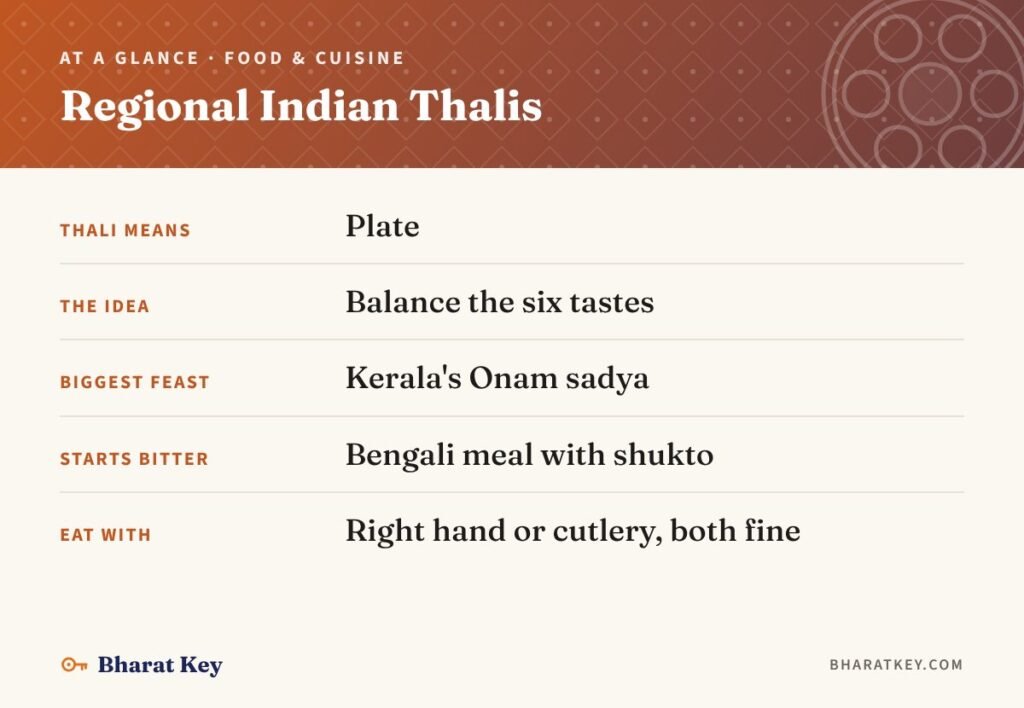
A thali is one of the best introductions to Indian food. The word means “plate”, and a thali meal is a complete spread of small dishes served together, usually on a steel or brass plate with small bowls (katoris), or on a banana leaf in the south. It is designed to balance flavours, textures and nutrition in a single sitting.
Because India’s cuisines change with climate, crops, history and religion, every region has its own thali. This guide to regional Indian thalis travels across the country, explains what you will find on each plate, and offers tips for ordering and eating them, whether you are in India or at an Indian restaurant abroad.
The idea behind the thali
Traditional Indian cooking aims to combine the six tastes, or shadrasa, described in Ayurveda: sweet, sour, salty, pungent, bitter and astringent. A good thali includes most of them, so that the meal feels complete and satisfying. You might find something sweet (a dessert or jaggery), something sour (pickle or kadhi), something salty (papad), something pungent (a spicy curry), something bitter (a bitter gourd dish) and something astringent (lentils or greens).
Most thalis contain:
- A staple: rice, flatbreads, or both
- Dal or another lentil dish for protein
- Vegetable dishes: dry (sabzi) and with gravy
- Yoghurt in some form: plain curd, raita or buttermilk
- Accompaniments: pickle, chutney, papad, salad
- A sweet
In many restaurants, thalis are “unlimited”: servers keep refilling until you signal that you are full.
Western India
Gujarati thali
The Gujarati thali is famous for its sheer number of dishes and its balance of sweet, salty and spicy. A typical plate includes dal (often slightly sweet and sour), kadhi (a yoghurt and gram flour curry), two or three vegetable dishes, farsan (snacks such as dhokla, khandvi or samosa), rotli (thin wheat flatbread), rice, khichdi, pickles, and a sweet such as shrikhand, basundi or mohanthal. In winter, the slow-cooked mixed vegetable dish undhiyu is a highlight.
Gujarati food is predominantly vegetarian, shaped by the influence of Jainism and Vaishnavism. Kathiawadi food from Saurashtra is spicier, with dishes such as sev tameta and ringan no olo (smoky mashed aubergine) served with bajra rotla (millet bread).
Rajasthani thali
Rajasthan’s desert climate produced a cuisine built on ingredients that last: lentils, gram flour, dried beans, millets and ghee. The signature dish is dal baati churma: baked wheat balls (baati) dipped in ghee, served with spicy lentils and sweet crumbled churma. Other favourites include gatte ki sabzi (gram flour dumplings in yoghurt gravy), ker sangri (desert berries and beans), bajre ki roti and papad ki sabzi. Non-vegetarian Rajasthani food is famous for laal maas, a fiery red mutton curry.
Maharashtrian thali
A Maharashtrian thali often includes varan bhaat (simple dal and rice with ghee and lemon), bhaji (vegetable dishes), amti (a tangy dal flavoured with goda masala or kokum), koshimbir (salad), chapati or bhakri, and sweets such as puran poli or shrikhand. In Kolhapur, the thali turns fiery with tambda rassa (red mutton curry) and pandhra rassa (white mutton broth). On the Konkan coast, fish and coconut dominate, with solkadhi, a pink drink of kokum and coconut milk, to cool the palate.
Goan meal
A Goan home meal centres on xitt kodi, rice with fish curry made from coconut, kokum and red chillies. Fried fish, prawn dishes, sorpotel and xacuti reflect the state’s Portuguese and Konkani heritage.
Northern India
Punjabi thali
The Punjabi thali is hearty, rich and generous. Expect dal makhani (black lentils simmered with butter and cream), rajma or chole, paneer dishes, seasonal vegetables, jeera rice, naan or tandoori roti, lassi and pickles. In winter, sarson da saag with makki di roti (mustard greens with cornbread) is essential, topped with a dollop of white butter.
Kashmiri wazwan
The wazwan is not a thali in the usual sense but a ceremonial multi-course feast associated with weddings in Kashmir, traditionally prepared by master cooks called wazas. It can include many courses, most of them meat: rista (meatballs in red gravy), rogan josh, tabak maaz (fried lamb ribs), yakhni (yoghurt-based curry) and, at the end, gushtaba (soft meatballs in white yoghurt gravy). Guests often share food from a large copper plate called a trami. Kashmiri Pandits have their own distinctive cuisine, which avoids onion and garlic and uses fennel, ginger powder and asafoetida.
Bihari and Uttar Pradesh meals
In Bihar, litti chokha (stuffed wheat balls with roasted aubergine and tomato mash) is iconic, along with sattu dishes. In Uttar Pradesh, a homestyle thali might include arhar dal, aloo sabzi, puri, kadhi, and seasonal greens, while Lucknow’s Awadhi cuisine is better known for kebabs and biryani.
Eastern and northeastern India
Bengali meal
A traditional Bengali meal is served in a strict sequence rather than all at once. It begins with something bitter, such as shukto (a mixed vegetable dish with bitter gourd), to awaken the palate. Next come dal with fritters, then vegetable dishes, followed by fish (macher jhol, shorshe ilish in mustard sauce) and perhaps mutton. The meal ends with chutney, papad and sweets like mishti doi and roshogolla.
Odia thali
Odia food is subtle and comforting. The thali often includes dalma (lentils cooked with vegetables), besara (vegetables in mustard paste), saga bhaja (stir-fried greens), and fish curries. In summer, pakhala bhata, fermented rice soaked in water and eaten with fried fish or vegetables, is a beloved cooling meal. Odisha is also proud of its sweets, especially chhena poda and rasagola. The Jagannath Temple’s mahaprasad, cooked in earthen pots, is a culinary tradition of its own.
Assamese thali
An Assamese thali traditionally begins with khar, a dish made with an alkaline extract from dried banana peel, believed to aid digestion. Other components include masor tenga (a light, sour fish curry), aloo pitika (mashed potato with mustard oil), duck or pork curries, and greens. Meals are light on spices and rich in herbs.
Northeastern plates
Across the Northeast, meals often feature rice with smoked meats, bamboo shoot, fermented soybean and fiery chillies. Look for smoked pork with bamboo shoot in Nagaland, jadoh (rice cooked with pork) in Meghalaya, eromba (a vegetable and fermented fish mash) in Manipur and the aromatic black rice chak-hao. Read our Northeast India travel guide for more.
Southern India
South Indian meals on a banana leaf
In much of South India, a full meal (simply called meals) is served on a banana leaf. In Tamil Nadu, you can expect rice, sambar, rasam, kootu (lentils with vegetables), poriyal (dry vegetable stir-fry), appalam, pickle, curd and payasam. Rice is eaten in courses: first with sambar, then with rasam, and finally with curd.
Kerala sadya
The Onam sadya is Kerala’s great vegetarian feast, served on a banana leaf with more than twenty dishes, sometimes many more. Highlights include avial (mixed vegetables in coconut and yoghurt), olan (ash gourd in coconut milk), kaalan (yam and banana in yoghurt), thoran (stir-fried vegetables with coconut), pachadi, erissery, sambar, parippu with ghee, banana chips, sharkara upperi and two or three kinds of payasam. The order in which dishes are placed on the leaf is fixed by tradition. Our Kerala travel guide has more on the state’s food.
Andhra and Telangana thali
Andhra food is famous for its heat. A thali might include pappu (dal, often with greens or tomato), gongura pachadi (sorrel leaf chutney), pulihora (tamarind rice), several curries, rasam, curd and fiery pickles like avakaya (mango). Hyderabadi meals add biryani and mirchi ka salan.
Karnataka meal
Karnataka’s thalis vary from Udupi temple-style vegetarian meals with saaru (rasam), huli (sambar) and kosambari salad, to north Karnataka’s jolada rotti (sorghum flatbread) with spicy vegetable curries, and coastal Mangalorean fish and chicken curries with neer dosa.
Thalis at a glance
| Thali | Staples | Signature dishes | Sweet to look for |
|---|---|---|---|
| Gujarati | Rotli, rice, khichdi | Kadhi, dhokla, undhiyu | Shrikhand, mohanthal |
| Rajasthani | Baati, bajra roti | Dal baati, gatte, ker sangri | Churma, ghewar |
| Maharashtrian | Chapati, bhakri, rice | Varan bhaat, amti, bharli vangi | Puran poli |
| Punjabi | Naan, roti, rice | Dal makhani, chole, saag | Phirni, kheer |
| Bengali | Rice | Shukto, macher jhol | Mishti doi, roshogolla |
| Odia | Rice | Dalma, besara, pakhala | Chhena poda |
| Assamese | Rice | Khar, masor tenga | Pitha |
| Tamil | Rice | Sambar, rasam, kootu | Payasam |
| Kerala sadya | Rice | Avial, olan, kaalan | Ada pradhaman |
| Andhra | Rice | Pappu, gongura, pulihora | Pootharekulu |

Temple food and community kitchens
Some of India’s most memorable meals are served not in restaurants but in temples and gurdwaras. At Sikh gurdwaras, the langar offers a free vegetarian meal to anyone, regardless of religion or background, with everyone sitting together on the floor. The langar at the Golden Temple in Amritsar serves tens of thousands of people every day, prepared largely by volunteers.
Many Hindu temples serve prasad meals. The Jagannath Temple in Puri cooks its mahaprasad in earthen pots stacked over wood fires, and the Udupi Sri Krishna Matha in Karnataka is closely linked with the Udupi style of vegetarian cooking found in restaurants across India. These meals carry the same principles as the thali: balance, simplicity and sharing.
Build a balanced thali at home
You do not need twenty dishes to enjoy a thali at home. Use this simple framework for an everyday plate:
- One grain: rice, roti, millet bhakri or a mix.
- One protein: dal, rajma, chole, sprouts, paneer, egg, fish or chicken.
- Two vegetables: one dry stir-fry and one with gravy, ideally of different colours.
- One cooling element: curd, raita or buttermilk.
- One sharp element: pickle, chutney or a squeeze of lemon.
- Something crunchy: papad, salad or a small portion of fritters.
- A little sweet: jaggery, a piece of fruit or a small dessert on special days.
This structure naturally brings variety and balance, and it adapts to whatever is in season wherever you live.
How to eat a thali
- Wash your hands. Many Indians eat thalis with their right hand. Cutlery is always fine.
- Start small. Taste each dish before mixing.
- Mix rice or bread with dal and curries. Tear flatbread with one hand and use it to scoop.
- Follow the sequence. In South Indian and Bengali meals, eat in the traditional order for the full experience.
- Do not waste food. In unlimited thalis, ask for small refills.
- Signal when you are done. Cover your plate with your hand when servers approach, or, on a banana leaf, fold the leaf towards you to show you enjoyed the meal.
Thalis abroad
Indian restaurants in the United Kingdom, United States, Canada, the UAE, Australia and Singapore increasingly serve regional thalis rather than a single pan-Indian menu. Look for restaurants run by people from the region, try weekend specials such as Onam sadya or Gujarati thali festivals, and ask staff to explain each dish. Home cooks abroad often adapt thalis with local vegetables, which is very much in the spirit of Indian cooking.
Dietary needs and thalis
Thalis are often a good choice for people with dietary preferences. Many regional thalis are fully vegetarian, and Jain thalis avoid root vegetables such as onion, garlic and potato. If you are vegan, ask about ghee, butter, curd and paneer, which appear in many dishes. If you avoid gluten, rice-based South Indian, Bengali, Odia and Assamese meals are naturally easier than wheat-heavy northern thalis, though asafoetida (hing) is sometimes blended with wheat flour. When in doubt, ask the restaurant to explain each dish; most are happy to help.
Key takeaways
- A thali is a balanced meal of several small dishes that aims to combine the six tastes of Ayurvedic tradition.
- Every region has its own thali, shaped by climate, crops, religion and history.
- Bengali and South Indian meals follow a traditional order, while many western thalis arrive all at once.
- Temple meals and gurdwara langars carry the same spirit of balance and sharing.
- You can build a simple balanced thali at home with a grain, a protein, two vegetables, curd and a sharp accompaniment.
Frequently asked questions
What is a thali?
A thali is a complete Indian meal of several small dishes served on a single plate or banana leaf, typically including a staple, dal, vegetables, yoghurt, accompaniments and a sweet.
Which Indian state has the best thali?
Every state has excellent thalis. Gujarati, Rajasthani, Kerala sadya and Bengali meals are among the most famous, but the best way to decide is to try several.
How many dishes are in an Onam sadya?
An Onam sadya usually includes more than twenty dishes, and elaborate versions can have many more, all served on a banana leaf.
Is it rude to eat a thali with a spoon?
No. Eating with your hand is traditional, but using cutlery is perfectly acceptable.
For more on Indian food, read our guides to Indian spices and Indian street food.