
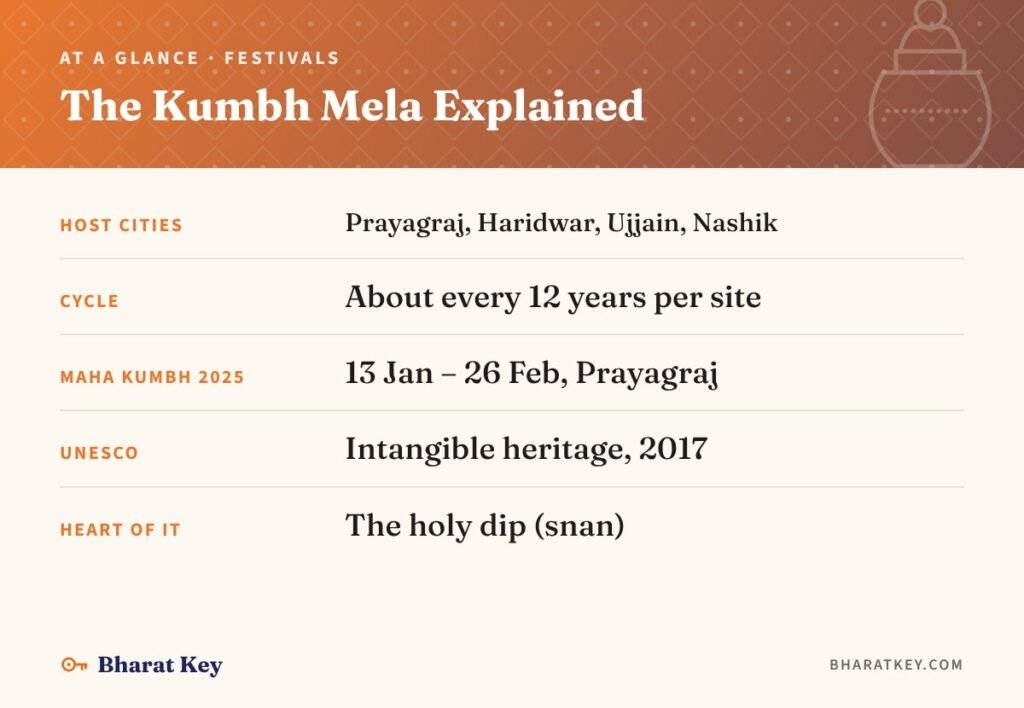
There is nothing else quite like the Kumbh Mela. For a few weeks, a riverbank in India becomes a temporary city with its own roads, bridges, hospitals, police stations and post offices, built to host pilgrims in numbers that rival the population of entire countries. At its centre are a few sacred moments when millions step into the water together.
In 2017, UNESCO inscribed the Kumbh Mela on its list of the Intangible Cultural Heritage of Humanity, describing it as the largest peaceful congregation of pilgrims on Earth. This explainer covers the legend behind it, how its calendar works, what happens there, and how to visit if you decide to go.
The legend of the pot of nectar
The word kumbh means a pot or pitcher. The festival’s origin story comes from the samudra manthan, the churning of the cosmic ocean described in the Puranas.
According to the legend, the gods (devas) and demons (asuras) agreed to churn the ocean together to obtain amrit, the nectar of immortality. When the pot of amrit finally emerged, a struggle broke out over who would keep it. In one version, Garuda carried the pot away; in another, Jayant, son of Indra, ran with it. During the chase, which lasted twelve divine days (equal to twelve human years), drops of nectar fell at four places on Earth:
- Prayagraj (formerly Allahabad), at the confluence of the Ganga, Yamuna and the mythical Saraswati
- Haridwar, on the Ganga
- Ujjain, on the Shipra
- Nashik, on the Godavari
These four places host the Kumbh Mela in rotation, and the belief is that bathing in their rivers at the astrologically appointed times brings spiritual purification and liberation.
A short history
Large religious gatherings at river confluences in India have a long history. The Chinese Buddhist pilgrim Xuanzang (Hiuen Tsang), who travelled in India in the 7th century, described a great assembly at Prayag under King Harshavardhana, where the king distributed his wealth to the people. Historians debate how directly this relates to the modern Kumbh, but it shows that Prayag was already a major place of pilgrimage.
Over the centuries, akharas, the monastic orders of ascetics, became central to the Kumbh. In the colonial period, British administrators began recording the gatherings and organising sanitation and crowd management, and the scale of the festival grew with the spread of railways. Today, the Kumbh is organised by the state governments of the host cities with support from the central government, and is one of the most complex logistical exercises in the world.
How the Kumbh calendar works
The timing of each Kumbh is determined by the positions of Jupiter (Brihaspati), the Sun and the Moon in particular zodiac signs. As Jupiter takes about twelve years to circle the zodiac, each site hosts a full Kumbh roughly every twelve years.
There are several types of mela:
| Type | Frequency | Where |
|---|---|---|
| Kumbh Mela | About every 12 years at each site | Prayagraj, Haridwar, Ujjain, Nashik |
| Ardh (half) Kumbh | About 6 years after a Kumbh | Prayagraj and Haridwar |
| Maha Kumbh | After twelve Kumbh cycles, about every 144 years, by popular reckoning | Prayagraj |
| Magh Mela | Every year in the month of Magh | Prayagraj |
| Simhastha | When Jupiter is in Leo (Simha) | Ujjain and Nashik |
The Ujjain and Nashik gatherings are called Simhastha because they take place when Jupiter is in the sign of Leo. In Nashik, the mela is shared with Trimbakeshwar, the source of the Godavari.
Maha Kumbh 2025
The most recent Maha Kumbh took place at Prayagraj from 13 January to 26 February 2025. The Uttar Pradesh government reported that more than 66 crore (660 million) visits were recorded over the festival, which would make it the largest gathering of people in history. Such figures are estimates based on crowd monitoring, transport data and other methods, but there is no doubt about the extraordinary scale.
The festival also saw tragedy: a crowd crush near the Sangam on Mauni Amavasya, one of the main bathing days, killed and injured pilgrims. It was a sobering reminder of the challenges of managing crowds of this size.
What’s next
Following the 2025 Maha Kumbh, the next major gatherings are expected at Haridwar (an Ardh Kumbh in 2027), Nashik-Trimbakeshwar (Simhastha in 2027) and Ujjain (Simhastha in 2028). Exact dates and bathing days are announced by the state governments and religious authorities, so always check the official Kumbh website or state tourism portals.
What happens at the Kumbh
The holy dip: snan
The heart of the Kumbh is the snan, the ritual bath. Pilgrims believe that bathing on certain auspicious days washes away sins and brings blessings. Major bathing days typically include Makar Sankranti, Paush Purnima, Mauni Amavasya, Basant Panchami, Maghi Purnima and Mahashivratri, depending on the mela.
The Amrit Snan of the akharas
On the most important days, the akharas lead processions to the river in a fixed order for the Amrit Snan, formerly known as the Shahi Snan or “royal bath”. Ascetics arrive on chariots, horses and elephants, with drums, flags and chants. The most famous are the Naga sadhus, naked ascetics covered in ash, who rush into the water. Their procession is one of the most photographed sights in the world.
There are thirteen traditionally recognised akharas, divided among Shaiva, Vaishnava and Udasin traditions. The order in which they bathe is settled by long-standing agreements and administered carefully to avoid disputes.
Kalpavas
Some devotees, known as kalpavasis, stay for the entire month of Magh on the riverbank, living simply in tents, bathing daily, fasting, attending discourses and performing rituals. Kalpavas is one of the oldest traditions at Prayagraj.
Discourses, music and charity
Across the mela grounds, camps run by spiritual organisations host pravachans (discourses), bhajans, kirtans and yoga sessions. Langars and community kitchens serve free meals. Many pilgrims also perform rites for their ancestors, and some take vows of renunciation.
The akharas explained
The word akhara originally meant a wrestling ground, and it still carries a sense of discipline and training. At the Kumbh, it refers to the organised orders of sadhus who live under shared rules and leadership. Their camps form the spiritual core of the mela.
The thirteen akharas recognised by the Akhil Bharatiya Akhara Parishad, the umbrella body, fall into three broad groups:
- Shaiva akharas, devoted to Shiva, which include the Juna, Niranjani and Mahanirvani akharas. The Juna Akhara is the largest and is home to many Naga sadhus.
- Vaishnava akharas, devoted to Vishnu and his avatars, often called bairagi akharas.
- Udasin akharas, which trace their origins to Sri Chand, the elder son of Guru Nanak, and the Nirmal akhara, which also has Sikh roots.
Each akhara is led by a hierarchy of mahamandaleshwars, mahants and other office-holders. New initiates, including those who choose to become Naga sadhus, are often formally inducted during the Kumbh. In 2025, women’s participation and the leadership of female ascetics received particular attention, reflecting gradual changes within these ancient institutions.
The river and the environment
The Kumbh depends on its rivers, and the rivers depend on how the festival is managed. Bringing tens of millions of people to a riverbank creates huge volumes of waste and sewage. In recent decades, authorities have invested in temporary sewage treatment, thousands of toilets, waste collection systems and river-surface cleaning boats, and have tried to reduce single-use plastic on the mela grounds.
Water quality remains a subject of scrutiny, with pollution control boards monitoring the rivers before and during the festival. For pilgrims, the most helpful steps are simple: use the toilets provided, carry reusable bottles and bags, avoid throwing plastic or offerings in plastic into the water, and follow local instructions.
Prayagraj beyond the mela
If you visit Prayagraj outside the mela season, the Sangam is still a peaceful place to take a boat ride at sunrise. The city also has a rich history beyond religion: the Allahabad Fort, built by Emperor Akbar in the 16th century, overlooks the confluence; Khusro Bagh contains elegant Mughal tombs; Anand Bhawan, the former Nehru family home, is now a museum about the freedom movement; and the University of Allahabad was once known as the “Oxford of the East”. Prayagraj is also linked with the Hindi poets Harivansh Rai Bachchan and Mahadevi Varma and the freedom fighter Chandra Shekhar Azad, after whom a park in the city is named.
The Kumbh in photographs and film
The Kumbh has drawn photographers and filmmakers for more than a century. Its images, from Naga sadhus running into the water to the sea of tents at night, have shaped how the world sees India. Today, social media has added millions of personal photographs and videos to that record. If you photograph the Kumbh, remember that it is first a place of worship: ask permission, respect privacy, and never use a drone without the required approvals.
How a temporary city is built
The scale of preparation is enormous. For a major Kumbh, authorities create:
- Pontoon bridges across the rivers
- Tent cities with sections for akharas, institutions and pilgrims
- Roads, electricity and water supply over thousands of hectares
- Hospitals, first-aid posts and ambulances
- Police and fire stations, control rooms and CCTV networks
- Toilets, waste management and river-cleaning systems
- Railway services and bus networks with special trains and buses
Recent Kumbhs have used technology extensively: GPS-tracked buses, mobile apps for navigation and lost-and-found, drone surveillance and data analytics for crowd management. Lost-and-found centres, known as khoya-paya kendras, help reunite family members who become separated in the crowds.
Visiting the Kumbh: practical tips
If you are thinking about visiting a Kumbh or Ardh Kumbh, plan carefully.
- Choose your days. The main bathing days are the most dramatic but also the most crowded. Visiting on other days is calmer and safer, especially for older people and children.
- Book accommodation early. Options range from basic dormitories and ashram stays to luxury tent camps run by private operators and state tourism departments.
- Stay connected. Agree on a meeting point with your group in case you get separated. Write phone numbers on a card for children and older relatives.
- Follow instructions. Use designated ghats and routes. Do not stop on bridges or in narrow lanes, and follow police directions.
- Dress practically. Wear comfortable shoes and layers; mornings by the river in January and February can be cold, especially at Prayagraj and Haridwar.
- Respect the ascetics. Ask before photographing sadhus, and never photograph people while they are bathing.
- Mind your health. Drink safe water, carry basic medicines and avoid swimming beyond marked areas.
- Be patient. Walking distances are long because vehicles are restricted in many zones.
Why the Kumbh matters
The Kumbh is a religious event, but it is also a vast meeting place of ideas and people. Saints and scholars debate philosophy; rural families travel by train for the first time; artists, photographers and researchers come from around the world. Economists study its impact on local economies, while urban planners study how a temporary city of this size can function.
For participants, its meaning is simpler: a chance to step into a sacred river alongside millions of others, in a tradition that connects them with countless generations before them.
If festivals fascinate you, read our guides to Durga Puja in Kolkata and Diwali around the world. For a different kind of mass event, our explainer on Census 2027 looks at how India counts its 1.4 billion people.
Key takeaways
- The Kumbh Mela rotates between Prayagraj, Haridwar, Ujjain and Nashik, following the positions of Jupiter, the Sun and the Moon.
- Its origin story is the churning of the ocean and the drops of amrit that fell at these four places.
- The holy dip on auspicious days and the Amrit Snan of the akharas are its central moments.
- The 2025 Maha Kumbh at Prayagraj recorded more than 660 million visits, according to the state government.
- Visitors should plan carefully, avoid the busiest days if possible and follow crowd-safety instructions.
- UNESCO recognised the Kumbh Mela as Intangible Cultural Heritage in 2017.
Frequently asked questions
What is the Kumbh Mela?
The Kumbh Mela is a Hindu pilgrimage festival held in rotation at Prayagraj, Haridwar, Ujjain and Nashik, where pilgrims bathe in sacred rivers at astrologically auspicious times.
How often is the Kumbh Mela held?
Each of the four sites hosts a Kumbh about every twelve years. An Ardh Kumbh is held at Prayagraj and Haridwar about six years after the Kumbh, and Prayagraj hosts a Magh Mela every year.
When was the last Maha Kumbh?
The last Maha Kumbh was held at Prayagraj from 13 January to 26 February 2025.
Is the Kumbh Mela on the UNESCO list?
Yes. UNESCO inscribed the Kumbh Mela on the Representative List of the Intangible Cultural Heritage of Humanity in 2017.
Can foreigners attend the Kumbh Mela?
Yes. People of all nationalities and faiths visit the Kumbh. Many state tourism departments run special camps and guided programmes for international visitors.