India’s classical dances are among the oldest continuous performance traditions in the world. They combine rhythm, music, poetry, theatre and devotion, and each carries the flavour of the region where it grew. This guide introduces the Indian classical dance forms recognised by the Sangeet Natak Akademi, India’s national academy for music, dance and drama, and explains how to watch them with fresh eyes.
The shared roots: Natya Shastra
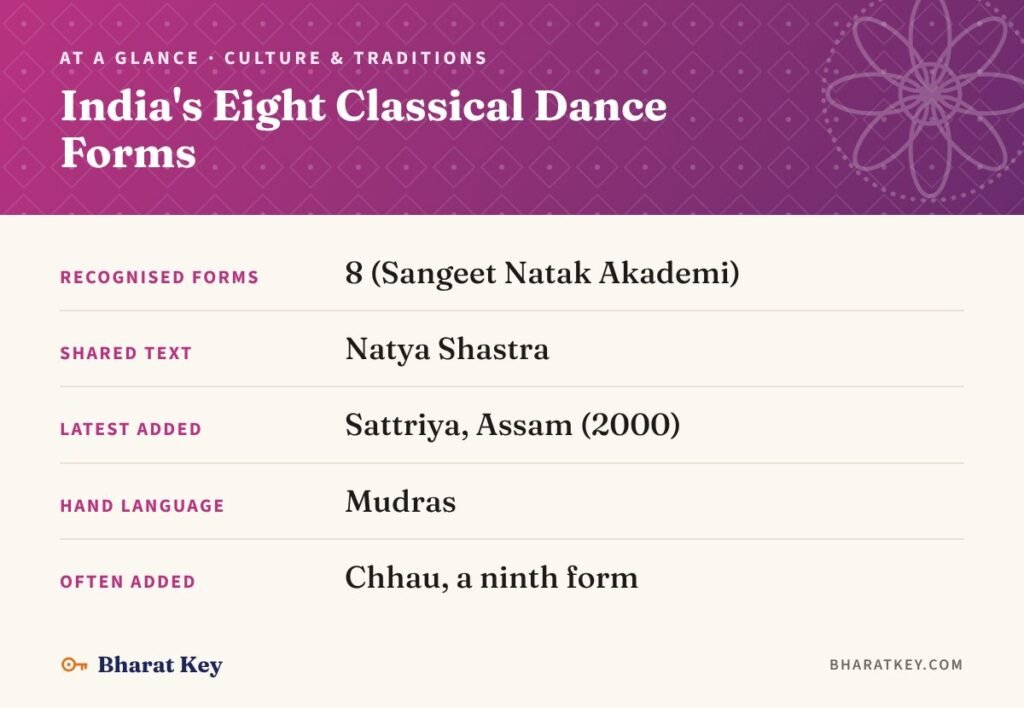
Almost every classical dance in India traces its theory to the Natya Shastra, a Sanskrit treatise on drama, dance and music attributed to the sage Bharata Muni. Scholars date its composition broadly to between roughly 200 BCE and 200 CE. In 2025, manuscripts of the Natya Shastra were added to UNESCO’s Memory of the World Register.
The Natya Shastra laid down ideas that remain central today:
- Nritta: pure dance, abstract movement focused on rhythm and line.
- Nritya: expressive dance that conveys meaning through gesture and facial expression.
- Natya: dramatic performance that tells a story, often with multiple characters.
- Abhinaya: the art of expression, through body (angika), speech or song (vachika), costume (aharya) and inner emotion (sattvika).
- Rasa: the aesthetic flavour or emotional experience evoked in the audience. The classical list includes love, laughter, compassion, anger, heroism, fear, disgust and wonder, with peace often added as a ninth.
Mudras: the language of the hands
Classical dancers use mudras, or hand gestures, as a kind of vocabulary. A single gesture can mean a lotus, a bird, a deer or a flag, depending on context. Combined with expressions of the eyes and face, mudras allow a dancer to narrate entire stories from the epics and devotional poetry.
The eight forms recognised by the Sangeet Natak Akademi
The Sangeet Natak Akademi currently recognises eight classical dance forms. The Ministry of Culture’s lists sometimes add Chhau, a vigorous masked dance from eastern India, as a ninth.
| Dance | Region | Signature features |
|---|---|---|
| Bharatanatyam | Tamil Nadu | Geometric lines, half-sitting posture, crisp footwork, rich abhinaya |
| Kathak | North India | Rapid footwork with ankle bells, spins, storytelling, Hindustani music |
| Kathakali | Kerala | Dance-drama with elaborate make-up, costumes and headgear |
| Kuchipudi | Andhra Pradesh | Fluid, dramatic dance; dancing on the rim of a brass plate |
| Odissi | Odisha | Sculptural poses, tribhanga (three bends) and chauka (square) stances |
| Manipuri | Manipur | Gentle, flowing movement; Raas Leela themes; no ankle bells in many pieces |
| Mohiniyattam | Kerala | Swaying, graceful movement; dance of the enchantress |
| Sattriya | Assam | Developed in Vaishnava monasteries (sattras); recognised in 2000 |
Bharatanatyam
Bharatanatyam developed in the temples and courts of Tamil Nadu, where it was performed by hereditary dancers. In the early 20th century, the tradition faced social stigma and legal bans on temple dancing. It was reshaped and brought to concert stages by artists such as Rukmini Devi Arundale, who founded the Kalakshetra academy in Chennai in 1936, and by the hereditary dancer T. Balasaraswati, whose expressive style remains a reference point.
Look for: the aramandi, a half-sitting posture with knees turned out; precise geometry of arms and legs; and the alternation between pure dance sections and expressive pieces.
A typical recital follows the margam, a sequence that opens with alarippu (an invocation), builds through jatiswaram and shabdam, reaches the centrepiece varnam, then moves to lyrical padams and ends with a fast tillana.
Kathak
The word Kathak comes from katha, story, and the dance is linked to the kathakars, storytellers who narrated epics in temples. Over centuries, it absorbed influences from the Mughal and Rajput courts. The result is a dance that balances devotion and courtly elegance.
Kathak has major gharanas (schools), including Lucknow, Jaipur and Banaras. Pandit Birju Maharaj of the Lucknow gharana is probably its most celebrated modern exponent.
Look for: fast footwork producing complex rhythms with hundreds of ankle bells; dazzling spins (chakkars); and conversational exchanges between dancer and tabla player.
Kathakali
Kathakali is a dance-drama from Kerala that grew in the 17th century from earlier theatre forms. Traditionally performed by men through the night, it tells stories from the Mahabharata, Ramayana and Puranas.
Kathakali’s make-up is a language in itself. Green faces (pacha) denote noble heroes; red and black patterns signal villains or complex characters; and a white paper frame along the jaw (chutti) takes hours to apply. The poet Vallathol Narayana Menon founded Kerala Kalamandalam in 1930 to revive and teach the art.
Look for: intense eye movements, often trained for years; enormous skirts and headgear; and the music of the chenda drum.
Kuchipudi
Kuchipudi takes its name from a village in the Krishna district of Andhra Pradesh. Its development is traditionally associated with Siddhendra Yogi, and it was originally performed as dance-drama by Brahmin men. Today it is performed by both women and men, in solo and group form.
Look for: a blend of brisk movement and theatrical expression; and the famous tarangam, in which the dancer performs while balancing on the rim of a brass plate, sometimes with a pot of water on the head.
Odissi
Odissi comes from Odisha, and its roots can be seen in temple sculptures across the state, including the musicians and dancers carved on the Konark Sun Temple. It developed from the traditions of temple dancers (maharis) and young male dancers (gotipuas). The 20th-century revival owes much to gurus such as Kelucharan Mohapatra.
Look for: the tribhanga, a posture with three bends at the neck, waist and knee; the square chauka stance associated with Jagannath; and lyrical pieces set to the Gita Govinda of Jayadeva.
Manipuri
Manipuri dance is closely tied to Vaishnava devotion in Manipur and especially to the Raas Leela, the divine dance of Krishna and the gopis. Movements are soft, rounded and flowing, and dancers in the Raas wear a distinctive stiff, cylindrical skirt. Male dancers perform the energetic Pung Cholom, playing the drum while leaping and spinning.
Look for: gentle, wave-like movements; minimal facial expression in many pieces, with emotion conveyed through the body; and costumes that glow under stage lights.
Mohiniyattam
Mohiniyattam, from Kerala, takes its name from Mohini, the enchantress form of Vishnu. It is a solo dance traditionally performed by women, and its swaying movements are often compared to palm trees in the breeze or the backwaters of Kerala.
Look for: white and gold costumes; a side bun hairstyle decorated with jasmine; and slow, lyrical movement emphasising grace.
Sattriya
Sattriya was developed in the 15th and 16th centuries by the saint and reformer Srimanta Sankardev as part of the neo-Vaishnava movement in Assam. For centuries it was performed by monks in the sattras (monasteries), especially on the river island of Majuli. It was recognised as a classical dance form in 2000.
Look for: costumes made from Assam’s silks; devotional themes centred on Krishna; and both masculine (paurashik bhangi) and feminine (stri bhangi) styles.
Chhau: the ninth form
Chhau is a semi-classical dance tradition found in three styles: Seraikella Chhau from Jharkhand, Purulia Chhau from West Bengal and Mayurbhanj Chhau from Odisha. It blends martial movements, acrobatics and folk traditions with stories from the epics. Purulia and Seraikella dancers wear striking masks, while Mayurbhanj Chhau is performed without them. Chhau was inscribed on UNESCO’s list of Intangible Cultural Heritage in 2010, and many cultural institutions treat it alongside the classical forms.
Gurus, gharanas and banis
Classical dance has always been passed on through lineages. In Kathak these are called gharanas; in Bharatanatyam they are often called banis, such as the Pandanallur, Vazhuvoor and Kalakshetra styles. Each lineage has its own approach to posture, rhythm, expression and repertoire.
This system of transmission, the guru–shishya parampara, means that a student learns not just steps but a way of seeing. Senior dancers often say that it takes a decade or more to absorb a style fully. Today, lineages also mix: dancers may train in more than one bani, collaborate across forms, or study with gurus in different cities.
Classical dance today
Classical dance in India is not a museum piece. It continues to change in several ways:
- New choreography: Contemporary choreographers use classical vocabulary to explore subjects such as climate change, gender, migration and urban life.
- Collaborations: Kathak dancers perform with flamenco artists, Bharatanatyam with jazz musicians, and Odissi with contemporary dancers, revealing unexpected connections.
- Film and television: Indian cinema has long drawn on classical dance, and many film stars trained in it. Songs choreographed in classical style continue to reach audiences who may never attend a recital.
- Online learning: Since 2020, many gurus teach online, allowing students in small towns and in the diaspora to learn from teachers far away. Most still recommend in-person training for correct posture.
- Fitness and wellbeing: Adults increasingly join classes for exercise, posture, memory and stress relief.
The music behind the dance
Classical dance is inseparable from music. South Indian forms such as Bharatanatyam, Kuchipudi and Mohiniyattam are generally accompanied by Carnatic music, with the mridangam drum, violin, flute, nattuvangam cymbals and a vocalist. Kathak is set to Hindustani music with tabla, harmonium, sarangi or sitar. Odissi has its own musical tradition, and Kathakali uses Sopana style singing with Kerala percussion.
How to enjoy a classical dance performance
You do not need to know every mudra to enjoy a recital. Try these approaches:
- Read the programme. Most performances include notes on each piece. Knowing the story makes the expressive sections far richer.
- Watch the eyes. Classical dancers use their eyes to direct attention and convey emotion. Follow them.
- Listen to the rhythm. In pure dance sections, notice how footwork and percussion interlock.
- Notice the repeated line. In expressive pieces, a single line of song may be repeated while the dancer explores different meanings. This is deliberate, not a mistake.
- Applaud at the end of a piece, not during it, unless others are doing so. In Kathak, audiences often applaud brilliant rhythmic passages.
Where to watch classical dance
- In India: The December Margazhi music and dance season in Chennai; the Khajuraho Dance Festival in Madhya Pradesh; the Konark Dance Festival in Odisha; and performances at Kerala Kalamandalam and Kalakshetra. Many cities have regular recitals at cultural centres.
- Abroad: Indian classical dance is taught and performed widely in the diaspora. In the United States and the United Kingdom, community schools hold annual recitals, and many students celebrate their first full solo performance with an arangetram (Bharatanatyam) or manch pravesh (Kathak). Cultural centres run by Indian missions abroad also host performances.
Learning a classical dance
Many parents in India and abroad enrol children in classical dance classes, and adults increasingly take them up for fitness and joy. A few tips:
- Choose a teacher, not just a school. Classical dance is passed on through the guru–shishya relationship. Watch a class before enrolling.
- Expect years, not months. A first full-length recital usually takes several years of regular training.
- Value theory and music. Good teachers explain the meaning of songs, mudras and rhythm, not just steps.
- Take care of your knees. Postures like the aramandi need correct alignment and gradual training.
Key takeaways
- The Sangeet Natak Akademi recognises eight classical dance forms, each rooted in a region of India.
- All draw on the Natya Shastra’s ideas of nritta, nritya, natya, abhinaya and rasa.
- Mudras and facial expression allow dancers to tell entire stories without words.
- Each dance has its own music, costume and repertoire, from Bharatanatyam’s margam to Kathakali’s dance-dramas.
- Watching with a programme in hand, and following the dancer’s eyes, makes any performance richer.
Frequently asked questions
How many classical dance forms are there in India?
The Sangeet Natak Akademi recognises eight: Bharatanatyam, Kathak, Kathakali, Kuchipudi, Odissi, Manipuri, Mohiniyattam and Sattriya. The Ministry of Culture also lists Chhau in some references, making nine.
Which is the oldest Indian classical dance?
All the classical forms draw on ancient traditions and the Natya Shastra, but their present forms evolved over many centuries. Bharatanatyam and Odissi are often described as among the oldest because of their links to temple sculpture and ritual.
Which classical dance was the latest to be recognised?
Sattriya, from Assam, was recognised by the Sangeet Natak Akademi in 2000.
What is the difference between Kathakali and Mohiniyattam?
Both come from Kerala. Kathakali is a dramatic dance-drama with elaborate make-up and costume, traditionally performed by men. Mohiniyattam is a graceful solo dance traditionally performed by women.
Can adults start learning classical dance?
Yes. Many teachers run adult batches, and beginners in their thirties, forties and beyond regularly take up Bharatanatyam, Kathak or Odissi. Progress may be slower than for children, especially in flexibility, but adults often bring better understanding of music and expression. Start with two classes a week, warm up properly and tell your teacher about any knee or back problems.
What should I wear to my first class?
Most schools ask beginners to wear a comfortable cotton salwar kameez or a practice saree, with a dupatta tied firmly around the waist. Ankle bells are introduced later, once basic footwork is secure.
For more on India’s living traditions, read our state-by-state guide to handloom sarees, many of which are worn on stage, and our feature on Indian wedding traditions.