Every time you write the number 2026, you are using an idea that took shape in India: a system of ten digits in which the value of each digit depends on its position, with a symbol for zero. This system travelled from India through the Arab world to Europe and eventually became the universal language of numbers.
The decimal system is only one of many ancient Indian contributions to science and mathematics. This article looks at the most important ones, from arithmetic and astronomy to surgery, metallurgy and linguistics. It also places them in context, because science has always grown through exchange between civilisations, and overstatement does no service to India’s genuine achievements.
Zero and the decimal place-value system
Many ancient civilisations had ways of writing numbers, but most were cumbersome. The Roman numeral system, for example, had no zero and made arithmetic difficult.
The great innovation that emerged in India was a combination of three ideas:
- Ten symbols for the digits from zero to nine.
- Place value, in which a digit’s value depends on its position (so the “2” in 20 means twenty, and in 200 means two hundred).
- Zero as a number, not just an empty placeholder.
The Bakhshali manuscript, found in 1881 in a village near Peshawar in present-day Pakistan, uses a dot as a placeholder zero. Radiocarbon dating published in 2017 by researchers at the University of Oxford suggested that parts of it may date back to the 3rd or 4th century CE, though the dating is debated by scholars. A clear inscription with a zero symbol also survives in the 9th-century Chaturbhuj Temple at Gwalior.
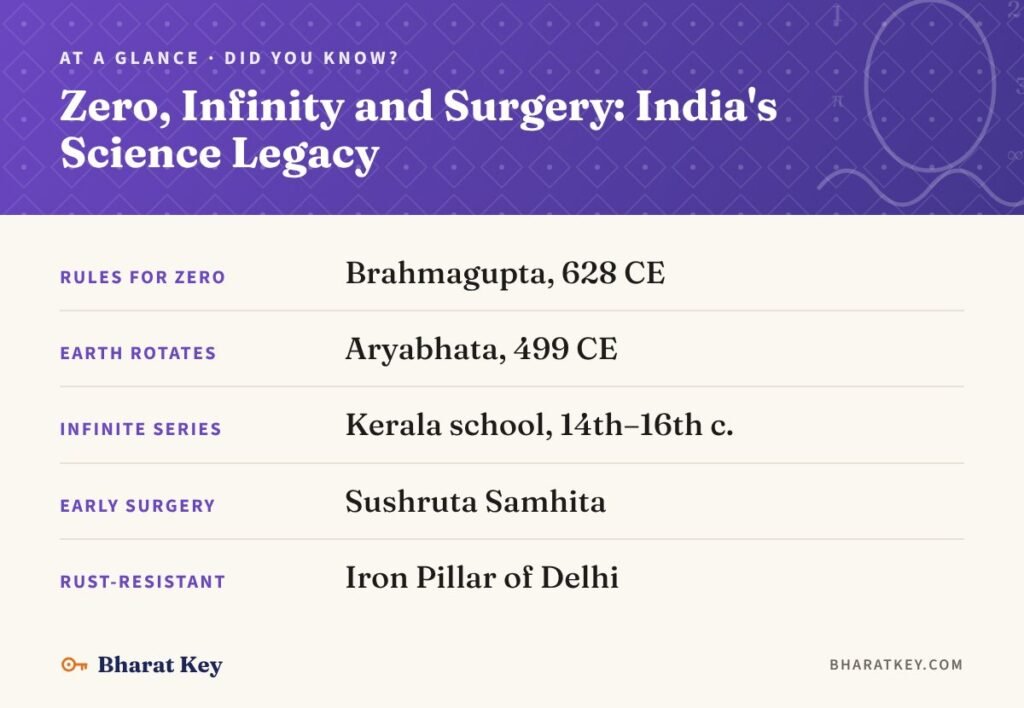
In 628 CE, the mathematician Brahmagupta wrote the Brahmasphutasiddhanta, which gave rules for arithmetic with zero and with negative numbers, treating debts as negative quantities. Some of his rules, such as division by zero, were later refined, but treating zero as a number in its own right was a profound step.
Through the work of the Persian mathematician al-Khwarizmi in the 9th century, and later the Italian Fibonacci in 1202, these “Hindu-Arabic numerals” spread to Europe, where they gradually replaced Roman numerals.
Aryabhata and Indian astronomy
Aryabhata, born in 476 CE, wrote the Aryabhatiya in 499 CE, when he was just 23. Its short verses cover arithmetic, algebra, trigonometry and astronomy. Among its notable ideas:
- The rotation of the Earth: Aryabhata proposed that the apparent daily motion of the stars is caused by the Earth rotating on its axis, an idea that was not widely accepted in his time.
- An accurate value for pi: He gave a value of 3.1416, describing it as approximate.
- Sine tables: He tabulated values of what we now call the sine function. The word “sine” itself has an Indian origin: the Sanskrit jya became jiba in Arabic, which was misread as jaib (meaning a fold or pocket) and translated into Latin as sinus.
- Eclipses: He explained solar and lunar eclipses in terms of the shadows of the Earth and Moon, rather than mythical causes.
India’s first satellite, launched in 1975, was named Aryabhata in his honour. Read about it in our article on India’s space programme.
Later astronomer-mathematicians such as Varahamihira, Brahmagupta and Bhaskara II built on this tradition, producing sophisticated methods for calculating planetary positions.
Geometry in the Sulba Sutras
The Sulba Sutras, ancient texts on constructing fire altars for Vedic rituals, contain geometric rules for creating precise shapes. The Baudhayana Sulba Sutra, dated to roughly the first millennium BCE, includes a statement equivalent to what we call the Pythagorean theorem for the diagonal of a rectangle, and an excellent approximation for the square root of 2. Similar knowledge existed in other ancient cultures, including Babylonia, which shows how widely such geometric insights developed.
Pingala, binary patterns and combinatorics
Pingala, who wrote the Chandahshastra, a treatise on Sanskrit poetic metres, is usually dated to the last centuries BCE. To analyse metres made of short and long syllables, he developed techniques that resemble a binary system and a method for counting combinations that corresponds to the triangle of numbers later known in Europe as Pascal’s triangle (called Meru Prastara in Indian texts).
The number sequence now known as the Fibonacci sequence also appears in Indian work on prosody, discussed by scholars such as Virahanka, Gopala and Hemachandra before Fibonacci’s time.
Bhaskara II and algebra
Bhaskara II (1114–1185) wrote the Siddhanta Shiromani, which includes the famous Lilavati, a book of arithmetic problems often framed as charming puzzles, and the Bijaganita on algebra. Building on Brahmagupta and the mathematician Jayadeva, he described the chakravala method, an elegant way to solve certain equations now known as Pell’s equations, centuries before European mathematicians tackled them.
The Kerala school and the roots of calculus
One of the most remarkable chapters in the history of mathematics took place in Kerala between the 14th and 16th centuries. Madhava of Sangamagrama founded a school of mathematicians and astronomers, including Nilakantha Somayaji and Jyeshthadeva, who discovered infinite series for pi, sine, cosine and arctangent.
These results, such as the series now often called the Madhava–Leibniz series for pi, anticipated work by European mathematicians such as Gregory, Newton and Leibniz by roughly two to three centuries. Jyeshthadeva’s Yuktibhasha, written in Malayalam, explains derivations of these results. Historians continue to study whether and how this knowledge might have reached Europe, possibly through Jesuit missionaries in Kerala, but there is no clear evidence of transmission.
Medicine and surgery: Sushruta and Charaka
Sushruta Samhita
The Sushruta Samhita, attributed to the physician Sushruta, is one of the world’s earliest detailed texts on surgery. It describes:
- More than a hundred surgical instruments.
- Procedures including cataract couching, removal of bladder stones and the treatment of fractures.
- Reconstructive surgery of the nose (rhinoplasty), using a flap of skin from the cheek or forehead.
- Training methods such as practising incisions on vegetables and leather.
In 1794, a London publication described an Indian surgeon performing a nose reconstruction using a forehead flap. This “Indian method” influenced the development of modern plastic surgery in Europe. Sushruta is often called the father of surgery in India, and the Royal Australasian College of Surgeons in Melbourne has a statue in his honour.
Charaka Samhita
The Charaka Samhita focuses on internal medicine, diagnosis, diet and the prevention of disease. It describes the importance of examining patients thoroughly and lays out ethical duties for physicians. Our Ayurveda beginner’s guide explains how these texts shape Ayurveda today, and what modern research says.
Metallurgy: rust-proof iron and fine steel
The Iron Pillar of Delhi
In the courtyard of the Qutub Minar complex in Delhi stands an iron pillar more than seven metres tall. An inscription in Sanskrit suggests it was made in the Gupta period, roughly 1,600 years ago. Despite centuries of exposure to the weather, it has barely rusted.
Metallurgists, including R. Balasubramaniam of IIT Kanpur, found that the iron’s high phosphorus content and the way it was forged helped form a thin, protective layer on the surface that slows corrosion. The pillar is a testament to the skill of ancient Indian ironworkers.
Wootz steel
South India and Sri Lanka produced a high-carbon crucible steel called wootz, made by melting iron with carbon-rich materials in sealed clay crucibles. Wootz was exported widely and is believed to have been the raw material for the legendary Damascus blades of the Middle East, prized for their strength and distinctive wavy patterns.
Zinc distillation
At Zawar, in Rajasthan, archaeologists have found evidence of large-scale zinc production using a sophisticated distillation process, dating back many centuries. Zinc is difficult to smelt because it boils at a relatively low temperature; Indian metallurgists solved this by using downward distillation in retorts, one of the earliest known industrial processes for producing metallic zinc.

Urban planning in the Indus Valley
The cities of the Indus Valley Civilisation, such as Harappa, Mohenjo-daro, Lothal and Dholavira, which flourished around 4,500 years ago, show remarkable planning: grid-like streets, standardised baked bricks, covered drains, public baths and standardised weights. Dholavira, in Gujarat, had an elaborate system of reservoirs to store water in a dry region and was inscribed as a UNESCO World Heritage Site in 2021. Lothal is often cited as having one of the earliest known dockyards.
This tradition of managing water carried on through India’s history, as seen in its magnificent stepwells.
Linguistics: Panini’s grammar
Around the 4th century BCE, Panini composed the Ashtadhyayi, a grammar of Sanskrit consisting of nearly 4,000 concise rules. It is so systematic that it has been compared to a formal system or computer program, generating correct words and sentences from roots and rules. Modern linguists, including Ferdinand de Saussure and Leonard Bloomfield, admired Panini’s work, and it continues to interest computer scientists working on language.
Astronomical observatories: Jantar Mantar
In the early 18th century, Maharaja Sawai Jai Singh II of Jaipur built five astronomical observatories, called Jantar Mantar, in Delhi, Jaipur, Ujjain, Varanasi and Mathura. The Jaipur observatory, a UNESCO World Heritage Site, includes the Samrat Yantra, one of the world’s largest stone sundials, which can tell local time to within a few seconds. The instruments combined Indian, Persian and European astronomical knowledge.
Centres of learning: Takshashila and Nalanda
Ideas need places to grow. Ancient India had famous centres of learning that attracted students from across Asia.
Takshashila (Taxila), in present-day Pakistan, was a renowned centre of learning from around the middle of the first millennium BCE. Tradition links it with figures such as the grammarian Panini, the political thinker Chanakya (Kautilya) and the physician Jivaka. Its ruins are a UNESCO World Heritage Site in Pakistan.
Nalanda, in Bihar, flourished from the 5th to the 12th centuries CE as one of the world’s earliest residential universities. It had libraries, lecture halls and monasteries, and taught Buddhist philosophy along with logic, grammar, medicine and other subjects. The Chinese scholar Xuanzang studied there in the 7th century and left detailed accounts. Nalanda was destroyed in the late 12th century. Its ruins were inscribed as a UNESCO World Heritage Site in 2016, and a modern Nalanda University has been established nearby, with a new campus inaugurated in 2024.
Other centres, such as Vikramashila in Bihar and Kanchipuram in Tamil Nadu, also attracted scholars. These institutions show that learning in ancient India was organised, international and deeply valued.
How numbers travelled
| Period | Development |
|---|---|
| Early centuries CE | Decimal place-value numerals develop in India |
| 628 CE | Brahmagupta sets out rules for zero and negative numbers |
| 8th–9th centuries | Indian astronomical and mathematical texts translated in Baghdad |
| c. 825 CE | Al-Khwarizmi writes on calculating with Indian numerals |
| 1202 | Fibonacci introduces the numerals to Europe in Liber Abaci |
| 15th–16th centuries | Printing helps Hindu-Arabic numerals replace Roman numerals in Europe |
Keeping it in perspective
It is important to celebrate these achievements accurately. Science in every civilisation has grown through exchange. Indian mathematicians learned from and contributed to Greek, Babylonian, Persian, Chinese and Arab traditions. Some popular claims about ancient Indian science, such as advanced aircraft or modern medical technologies in ancient texts, are not supported by historical evidence and can distract from the real, well-documented contributions described here.
What emerges from the evidence is impressive enough: a long tradition of careful observation, abstract thinking and practical ingenuity that helped shape the modern world.
Key takeaways
- The decimal place-value system with zero, now used worldwide, took shape in India.
- Aryabhata, Brahmagupta, Bhaskara II and the Kerala school made major advances in astronomy and mathematics.
- The Sushruta Samhita describes early surgical techniques, including reconstructive nose surgery.
- The Iron Pillar of Delhi and wootz steel show the skill of ancient Indian metallurgists.
- These achievements are best understood as part of a global exchange of knowledge, without exaggeration.
Frequently asked questions
Did India invent zero?
The concept of zero as a number, with rules for calculating with it, was developed in India and set out by Brahmagupta in 628 CE. Other cultures, such as the Babylonians and Maya, used placeholder symbols, but the Indian concept, combined with the decimal place-value system, is the one used worldwide today.
Who was Aryabhata?
Aryabhata was a 5th-century Indian mathematician and astronomer who wrote the Aryabhatiya in 499 CE, proposing the Earth’s rotation, giving an accurate value of pi and tabulating sine values.
What did the Kerala school of mathematics discover?
The Kerala school, founded by Madhava of Sangamagrama, discovered infinite series for pi and trigonometric functions between the 14th and 16th centuries, anticipating key ideas in calculus developed later in Europe.
Why doesn’t the Iron Pillar of Delhi rust?
Its high phosphorus content and the way the iron was forged helped form a protective surface layer that greatly slows corrosion.
Who is called the father of surgery in India?
Sushruta, whose Sushruta Samhita describes surgical instruments and procedures, including reconstructive nose surgery.
For more surprising stories, read our list of 30 interesting facts about India and our feature on Indian women in science.