Ladakh feels like another world. Brown and ochre mountains rise above valleys dotted with whitewashed monasteries and green barley fields. Lakes glow an impossible blue. The sky is so clear at night that the Milky Way seems close enough to touch. For many travellers, it is the most dramatic landscape in India.
Ladakh is also a high-altitude desert, and the thin air requires careful planning. This Ladakh travel guide covers how to acclimatise, when to go, how to get there, the essential sights and how to travel responsibly in a fragile environment.
Ladakh in brief
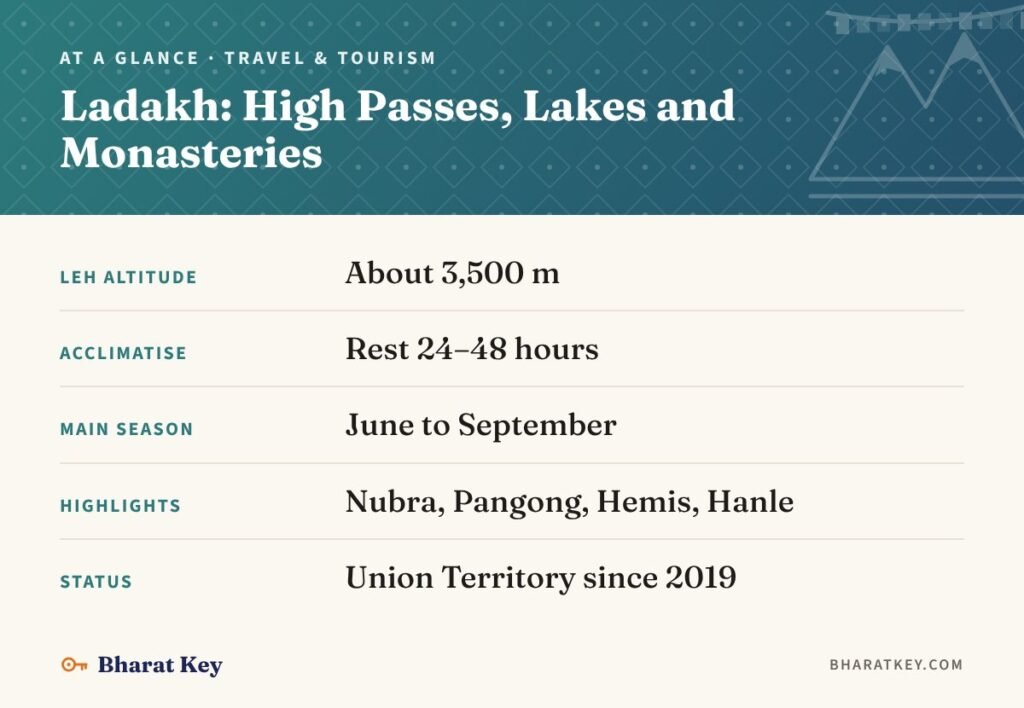
Ladakh lies in the far north of India, between the Karakoram and the Great Himalaya. It has been a Union Territory since 31 October 2019, with two districts that have since been reorganised and expanded. Leh is its main town and the base for most visitors. Kargil is the second major town, on the route from Srinagar.
Historically, Ladakh was an independent Himalayan kingdom with close ties to Tibet. It sat on trade routes linking Central Asia, Tibet and India, which is why caravans of pashmina, salt and other goods once passed through Leh. Tibetan Buddhism shapes much of its culture, while Kargil and some other areas are predominantly Muslim.
Altitude: the most important thing to know
Leh sits at around 3,500 metres above sea level, and many popular destinations are higher. At this altitude, there is significantly less oxygen in each breath, and acute mountain sickness (AMS) is a real risk for anyone, regardless of fitness.
How to acclimatise
- Rest for the first 24–48 hours after arriving in Leh, especially if you fly in. Avoid exertion, sightseeing marathons and stairs on day one.
- Drink plenty of water but avoid alcohol and smoking for the first few days.
- Ascend gradually. Do not go to high-altitude places such as Khardung La, Pangong or Tso Moriri until you have spent at least two nights in Leh.
- Sleep lower than you go. Day trips to high passes are easier than sleeping at high altitude.
- Know the symptoms. Headache, nausea, dizziness, fatigue and trouble sleeping are common signs of AMS. If symptoms worsen, or if you experience breathlessness at rest, confusion or difficulty walking, descend immediately and seek medical help.
- Talk to a doctor before your trip, especially if you have heart or lung conditions or are pregnant. Some travellers take preventive medicine under medical advice.
When to visit
| Season | Months | What to expect |
|---|---|---|
| Spring | April–May | Clear skies, cold nights; high passes may be snowbound |
| Summer | June–September | Peak season; all roads open, pleasant days, cool nights |
| Autumn | October | Golden poplars, fewer visitors, colder nights |
| Winter | November–March | Very cold; roads to Leh often closed; flights operate |
June to September is the main season, when both highways to Leh are usually open. The light is harsh in midsummer; spring and autumn offer softer light and fewer crowds. Winter travel is possible by air for experienced and well-prepared travellers, and it offers the frozen-river Chadar trek in Zanskar and snow leopard tracking in Hemis National Park.
Getting to Ladakh
By air
Kushok Bakula Rimpochee Airport in Leh has direct flights from Delhi and some other cities year-round. Flights over the Himalaya are spectacular; sit on the left side from Delhi for mountain views on clear days.
By road
- Manali–Leh Highway: About 430 km, crossing high passes such as Baralacha La and Tanglang La. The Atal Tunnel under the Rohtang Pass, opened in 2020, has shortened the route. Most travellers take two days, stopping overnight at Jispa or Sarchu.
- Srinagar–Leh Highway: About 420 km, via Sonamarg, the Zoji La pass, Drass and Kargil. This route has a gentler altitude gain and is better for acclimatisation.
Both roads are usually open from late spring to autumn, depending on snow. Travelling by road allows gradual acclimatisation and is an unforgettable experience, but it is long and tiring.
Leh: the base
Things to do in Leh
- Leh Palace: A nine-storey palace built in the 17th century by King Sengge Namgyal, overlooking the old town.
- Shanti Stupa: A white stupa completed in 1991, with panoramic views at sunset.
- Old town walks: Explore traditional mud-brick houses and narrow lanes, many restored by local conservation groups.
- Leh Market: For pashmina, apricots, Tibetan handicrafts and cafés.
- Hall of Fame: A museum run by the Indian Army about the region’s military history.
Monasteries near Leh
- Thiksey: A striking monastery climbing a hill, often compared to the Potala Palace in Lhasa. Attend the early-morning prayers.
- Hemis: The largest monastery in Ladakh, famous for the Hemis Festival, a masked dance festival held in summer to celebrate Guru Padmasambhava.
- Shey Palace: A former royal summer palace with a large Buddha statue.
- Stakna and Matho: Smaller monasteries with beautiful settings.
- Alchi: About 70 km west of Leh, with remarkably preserved 11th-century murals.
- Lamayuru: Set amid eroded “moonland” landscapes, one of the oldest monasteries in Ladakh.
Nubra Valley
Nubra lies north of Leh, across the Khardung La pass. It is a valley of sand dunes, villages and orchards along the Shyok and Nubra rivers.
- Khardung La: The pass is often promoted as one of the world’s highest motorable roads. Signs at the top have long claimed a height above 5,600 metres, though independent measurements put it lower, at around 5,350 metres. Either way, do not linger too long at the top.
- Diskit Monastery: Known for its large statue of Maitreya Buddha overlooking the valley.
- Hunder: Famous for its sand dunes and double-humped Bactrian camels.
- Turtuk: A village near the Line of Control, home to the Balti community, with apricot orchards and a distinct culture. It was opened to tourists in 2010.
Pangong Tso
Pangong Tso is a long, narrow lake that stretches from Ladakh into Tibet, with most of its length lying beyond India’s side of the Line of Actual Control. It changes colour from turquoise to deep blue with the light. The lake sits at around 4,250 metres, so nights are very cold even in summer. Most visitors stay overnight in camps or guesthouses at Spangmik, Lukung or Merak, or travel on to Nubra via the Shyok route when it is open.
Tso Moriri and Changthang
Tso Moriri is a quieter, more remote high-altitude lake, protected as a wetland and home to the nomadic Changpa people, who raise the goats that produce pashmina. Birdwatchers come for bar-headed geese and black-necked cranes. Nearby Tso Kar is a salt lake.
Hanle: India’s dark sky reserve
Hanle, in eastern Ladakh, hosts the Indian Astronomical Observatory and was declared India’s first Dark Sky Reserve in 2022. Villages around Hanle have trained “astro ambassadors” who guide visitors through the night sky. Light pollution is strictly controlled, so follow local guidance.

Zanskar
Zanskar is one of the most remote regions of Ladakh, reached via Kargil or, increasingly, new roads from Himachal Pradesh. It is famous for monasteries such as Phugtal, built into a cliff, and for the winter Chadar trek on the frozen Zanskar river, which requires specialist preparation and is regulated by the authorities.
Permits and fees
Some areas of Ladakh, including Nubra, Pangong, Tso Moriri, Hanle, Turtuk and parts of Dah-Hanu, are close to international borders. Depending on your nationality and destinations, you may need a permit and to pay environmental or wildlife fees. Foreign nationals require a Protected Area Permit, usually arranged through a registered travel agent. Rules change periodically, so check the official Ladakh tourism website or ask your hotel or tour operator in Leh.
Carry multiple photocopies of your permits and identity documents, as checkpoints may ask for them.
Ladakhi culture and festivals
Ladakh’s festivals offer a window into its Buddhist and Himalayan heritage. Many monasteries hold annual festivals with cham, masked dances performed by monks in elaborate costumes to depict the victory of good over evil and teachings of Buddhism.
- Losar: The Ladakhi New Year, celebrated in winter, usually in December, with rituals, lamps and family gatherings.
- Hemis Tsechu: Held in summer at Hemis Monastery to celebrate Guru Padmasambhava’s birth anniversary, with masked dances in the monastery courtyard.
- Thiksey Gustor and Spituk Gustor: Winter and late-year monastery festivals with cham dances.
- Ladakh Festival: Organised by the tourism department, usually in September, with cultural performances, archery, polo and processions in Leh.
- Sindhu Darshan: A festival on the banks of the Indus near Leh, usually in June, celebrating the river.
Dates follow the Tibetan lunar calendar and change each year, so check the Ladakh tourism calendar. During festivals, dress modestly, do not walk through the dance area, and ask permission before photographing monks.
Everyday culture is just as rewarding. In villages you may see the traditional goncha robe, the perak (a headdress studded with turquoise worn by some women on special occasions), and the practice of farming barley in terraced fields watered by glacial streams. Many Ladakhi homes still have a traditional kitchen with polished copper and brass utensils, and visitors may be offered butter tea (gur gur cha), a salty tea churned with butter.
Getting around
- Taxis: Leh’s taxi union operates fixed-rate services to most destinations. Self-drive rental cars from outside Ladakh face restrictions, so check the current rules.
- Motorbikes: Renting a motorbike in Leh is popular. Ride only if you are experienced, wear proper gear, carry spare fuel where needed and never ride at night.
- Shared taxis and buses: Cheaper but slower, and schedules can change.
What to pack
- Layers: Thermal underwear, fleece, a down jacket and a windproof shell, even in summer.
- Sun protection: High-SPF sunscreen, UV-protective sunglasses, a hat and lip balm. The sun is very strong at altitude.
- Medicine kit: Including any personal medicines and basic first aid.
- Reusable water bottle: Refill from filtered water stations in Leh.
- Cash: ATMs are limited outside Leh, and mobile networks are patchy. Many remote places accept only cash.
- Power bank: Electricity can be limited in camps.
Food in Ladakh
Ladakhi food is simple and warming. Try thukpa (noodle soup), skyu (hand-pressed pasta stew), momos, khambir (local bread) with butter tea, and apricot dishes in season. In Leh, cafés serve everything from Tibetan to Italian and Israeli food, catering to international travellers.
Responsible travel in Ladakh
Ladakh’s environment is fragile. Water is scarce, waste management is limited and tourism has grown rapidly.
- Avoid bottled water. Use refill stations and carry a reusable bottle.
- Minimise waste. Carry your rubbish back from remote areas.
- Stay in homestays to support local families.
- Respect monasteries. Dress modestly, ask before photographing monks or prayers, and walk clockwise around stupas and prayer wheels.
- Do not drive off-road at lakes and grasslands; it damages fragile soils.
- Save energy and water in hotels.
A sample eight-day itinerary
- Days 1–2: Arrive in Leh and rest; gentle walks in the old town and Shanti Stupa
- Day 3: Monasteries: Thiksey, Shey and Hemis
- Days 4–5: Nubra Valley via Khardung La: Diskit, Hunder, optional Turtuk
- Days 6–7: Pangong Tso via the Shyok route or via Leh and Chang La
- Day 8: Return to Leh and depart, or continue to Alchi and Lamayuru
For more mountain and nature journeys, read our Northeast India travel guide. For a gentler introduction to India, see our two-week itinerary.
Key takeaways
- Leh sits at about 3,500 metres, so resting for 24 to 48 hours on arrival is essential.
- June to September is the main season, when both highways are usually open.
- Must-see areas include Leh’s monasteries, Nubra Valley, Pangong Tso, Tso Moriri and Hanle’s dark skies.
- Permits and environmental fees may apply for border areas, and foreign nationals need a Protected Area Permit.
- Responsible travel matters in Ladakh’s fragile desert: refill water, minimise waste and stay in homestays.
- Carry cash, layers and sun protection, as remote areas have limited services and the sun is intense.
Frequently asked questions
What is the best time to visit Ladakh?
June to September is the main season, when roads are open and the weather is pleasant. May and October are quieter with colder nights.
How many days do I need for Ladakh?
At least seven to eight days, including two days to acclimatise in Leh. Ten to twelve days allow time for Tso Moriri, Hanle or Zanskar.
Is Ladakh safe for families and older travellers?
Many families and older travellers visit Ladakh. The main concern is altitude. Consult a doctor before travelling, acclimatise properly and avoid rushing to high places.
Do Indians need a permit for Ladakh?
Requirements change from time to time. Depending on the places you visit, you may need a permit or to pay environment fees. Check the official Ladakh administration website before your trip.
Can I drive my own car to Ladakh?
Many travellers drive to Ladakh from Manali or Srinagar. Rules on outside vehicles and rented self-drive cars within Ladakh change from time to time, so check current local regulations and carry all vehicle documents.